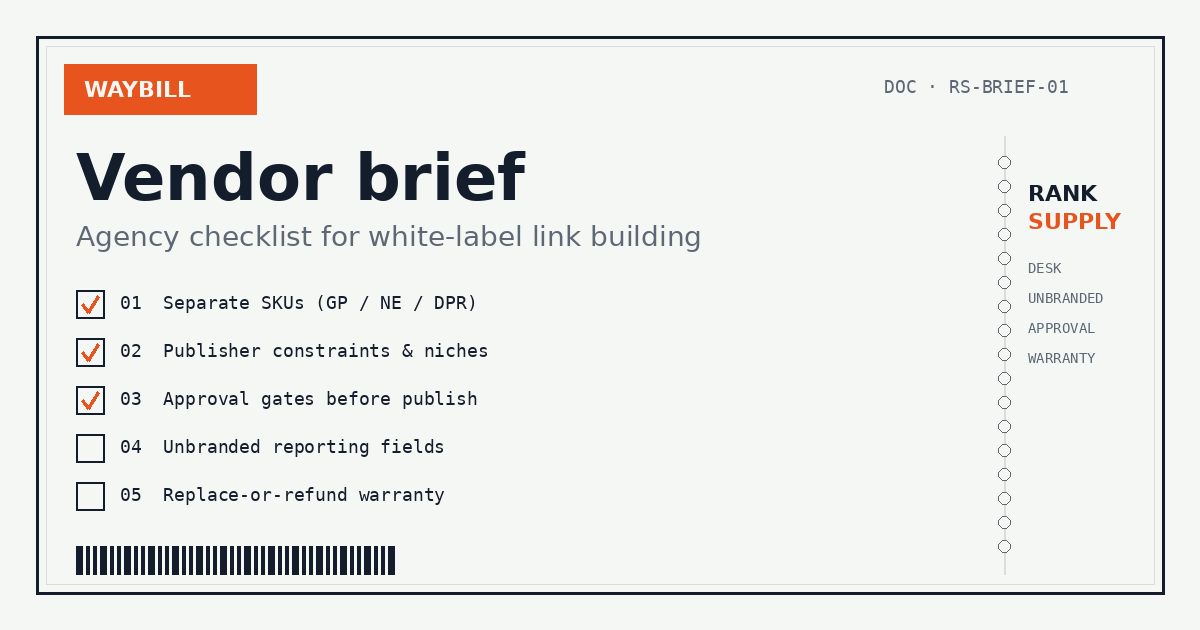
FIG. — Vendor brief as a waybill: SKUs, constraints, approvals, unbranded report fields, warranty line.
Most agency–vendor friction is not about “bad links.” It is about a vague brief. The strategist meant niche edits on aged SaaS URLs; the desk heard guest posts. The client expected unbranded PDFs; the report arrived with a third-party logo. The warranty was “we’ll look into it” instead of replace-or-refund. A clear white-label link building vendor brief prevents that — and it protects your book of business when you resell through a white-label desk or an SEO agency fulfillment lane.
This checklist is written for SEO agencies that outsource placement work and keep the client relationship. Inventory context only: RankSupply works from a sheet with 100k+ publishers and roughly 500 SaaS niche-edit options. Featured publisher names on any sheet are inventory examples, not owned media. No ranking guarantees. No invented ROI.
What belongs in a white-label vendor brief
Treat the brief like a shipping manifest. If a field is not on the page, do not assume the vendor will invent it correctly under your brand.
- Client context (internal only) — niche, geo (US / UK / CA), sensitive topics, brand voice notes. Do not put your client’s confidential strategy into a shared Slack that the vendor’s freelancers can scrape.
- SKU mix and volume — exact counts per lane (guest post / niche edit / Digital PR), not a lump “10 links.”
- Target URLs and anchor rules — money pages vs blog, exact-match caps, branded vs naked URL mix.
- Publisher constraints — min traffic or topical fit, banned categories, language/geo, no PBN language.
- Approval gates — who signs off on host, draft/insert, and live URL before you bill the client.
- Reporting format — unbranded template fields, DF/NF labeled, delivery cadence.
- Warranty — replace-or-refund window and what triggers it.
- Refuse list — niches or tactics you will not fulfill even if the client asks.
If you are still choosing lanes, read guest posts vs niche edits vs Digital PR first — then write the brief with those SKU names only.
Separate SKUs: guest posts, niche edits, Digital PR
Never brief “links” as one line item. White-label fulfillment desks price and QA differently per SKU.
Guest posts
New article, new permalink, link in editorial copy. Brief the topical fit, word-count band, byline rules, and whether you supply the draft or the vendor does. Service lane: guest posting service. Vet hosts with how to vet guest post sites before you approve a domain for a client who trusts your judgment.
Niche edits
Insert into an existing, aged, indexed URL — not a new post. Brief the preferred topical adjacency and any hard excludes. Service lane: niche edits. SaaS-heavy books should say so explicitly; depth on the sheet (~500 SaaS niche edits) only helps if you ask for it.
Digital PR
Media outreach with outcomes that may include coverage, mentions, and links. Brief the story asset (data, launch, expert POV), not “ten DF by Friday.” Require DF/NF labeled on delivery. Service lane: Digital PR.
Price bands are educational only — see link building costs. The brief sets scope; the quote sets price. Reseller framing lives on link building reseller.
Publisher constraints to put in writing
- Quality floor — e.g. verified organic traffic over vanity DR alone; no expired-domain traps.
- Topical fit — adjacent categories allowed vs hard off-topic.
- Geo / language — US, UK, CA English unless the client brief says otherwise.
- Outbound hygiene — reject footer farms and sitewide spam patterns.
- Disclosure — if a placement is sponsored or NF, the report must say so.
Constraints protect your agency more than they slow the desk. A vendor who cannot accept written constraints is selling hope, not inventory.
Approval gates (before publish)
White-label only works when you remain the gate. Put three gates in the brief:
- Host approval — domain + metrics + sample URL before outreach or insert negotiation.
- Copy / insert approval — draft guest post or proposed insert paragraph + anchor.
- Live QA — live URL, follow attribute, surrounding context, indexability check before you forward the report to the client.
State turnaround SLAs in business days for each gate so “waiting on approval” does not become an invisible delay on your client timeline.
Unbranded reporting fields
Your client should never see the vendor’s brand. Specify the report columns you need on every delivery:
- Live URL
- Target URL (client page)
- Anchor text
- SKU type (guest post / niche edit / Digital PR)
- Follow attribute (DF or NF) — labeled, never “assumed”
- Publish date
- Publisher domain (and optional traffic note)
- Warranty status / replacement ID if applicable
PDF or sheet template under your letterhead. That is the difference between fulfillment and a reseller who leaks. Soft CTA when you want the sheet: request a quote or join agency offers for wholesale drops.
Replace-or-refund warranty expectations
Put the warranty in the brief, not in a footnote after invoice:
- Trigger — link removed, page 404, or agreed follow attribute flipped without disclosure.
- Window — calendar months after delivery (state the number).
- Remedy — replacement on a comparable host or refund for that line item.
- Exclusions — client-requested removals, site-wide publisher bankruptcies you both accept as force majeure, or NF placements you already labeled NF.
“We’ll try” is not a warranty. Agencies reselling white-label work need a remedy they can explain to a client without improvising.
Refuse niches and sensitive topics — say it honestly
A good vendor brief includes what you will not buy. Adult, illegal, hate, clear YMYL spam tactics, fake news, and anything that would embarrass your agency on a compliance review should be named. If the client niche is gray (supplements, crypto, aggressive finance), write the allowed framing and the hard stops. Honesty here is cheaper than a cleanup campaign later. RankSupply’s desk will refuse work that does not fit editorial or legal comfort — put that expectation in writing so nobody is surprised mid-month.
Sample brief outline (copy/paste)
| Section | What to write |
|---|---|
| Header | Agency name, month, client code (not full legal name if you prefer), geo |
| SKU table | Count × guest post / niche edit / Digital PR; target URLs; anchor rules |
| Publisher rules | Traffic floor, topical fit, language, exclude list |
| Approvals | Named approver + SLA for host / copy / live |
| Reporting | Unbranded columns; DF/NF required; delivery day |
| Warranty | Replace-or-refund window + triggers |
| Refuse list | Niches / tactics out of scope |
| Contacts | Agency PM only — vendor must not contact the end client |
Keep it to one or two pages. Long novels get skimmed; manifests get followed.
Red flags in a vendor’s reply to your brief
- Cannot separate guest posts from niche edits on the quote.
- Promises rankings, “guaranteed page-one,” or ROI multiples.
- Will not label DF vs NF before or on delivery.
- Refuses pre-publish host or copy approval.
- Wants to email your client “for faster turnaround.”
- Warranty is verbal only.
- Inventory is “trust the network” with no named domains you can verify.
- Pushes one SKU for every brief regardless of strategy.
Walk. Your brand sits on the report; their shortcuts become your incident.
How this fits the fulfillment workflow
Brief → host shortlist → approvals → publish → unbranded report → warranty watch. That is the loop behind white-label link building and day-to-day agency fulfillment. Educational pricing context stays in the 2026 cost guide; commercial next step is a quiet quote request when you have a month’s SKU table ready.
FAQ
How detailed should a white label link building brief be?
Detailed enough that a new desk operator could fulfill without Slack archaeology: SKU counts, targets, constraints, approvals, report fields, warranty. Skip ranking narratives — they do not help fulfillment.
Can one brief cover guest posts and niche edits together?
Yes, if they appear as separate line items with separate constraints. Mixing them into “10 links” is how agencies get the wrong SKU.
What is the minimum warranty language to demand?
Replace-or-refund for drop or undisclosed follow-attribute change within a stated window. Soft “monitoring” without remedy is not enough for resale.
Last reviewed: 11 September 2026 (Asia/Karachi). Part of Vertan. Contact hi@ranksupply.io · +1-210-293-2152.