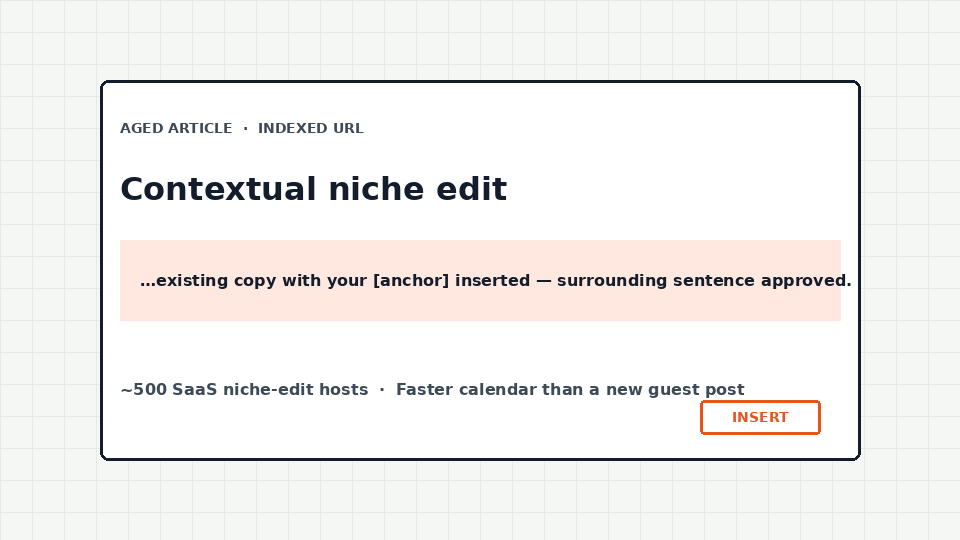
A niche edit places your client's link inside an existing, indexed article that already has age, authority, and often its own rankings. No new content to wait on — which makes it the fastest and cheapest placement type on our sheet.
Guest posts build new assets; niche edits borrow existing ones. The practical difference for your campaign timeline is a placement that's live within the week.
| Dimension | Niche edit | Guest post |
|---|---|---|
| What you get | Link added into an existing, indexed article | New article written and published for you |
| Time to live | 3–7 days | 10–21 days |
| Sheet rate | from $40 | from $50 |
| Page authority at launch | Aged page, often already ranking | New page, builds from zero |
| Content control | Anchor + surrounding sentence | Full article, your brief |
| Best used for | Velocity, supporting links, fast wins | Flagship links, topical depth, brand mentions |
Most agency campaigns we fulfill run both: guest posts as the anchor placements, niche edits filling velocity between them. Your account manager will map a mix to each client's budget.
A niche edit is only as good as the article it lands in. Ours go into indexed pages on the same 300+ vetted publications our guest posts run on — never into link farms built to sell insertions.
The target article must be indexed in Google, topically relevant to your client, and receiving organic traffic — checked per placement, not per domain.
Exact URL, anchor text, and the sentence your link sits in — approved by you before anything is edited into the page.
Delivered DoFollow, re-crawled, and reported with the live URL and page metrics.
Same warranty as guest posts: if the link drops or loses DoFollow, we replace or refund.
A representative scenario built from real sheet mechanics — not a named client. It shows where a link insertion beats a fresh placement.
An agency has a client campaign due in two weeks and can't wait 10–21 days for guest-post editorial calendars. They need 3 contextual links placed into existing, already-indexed articles on relevant DR 50–65 domains.
The appeal of a niche edit isn't just speed. It's that the host page already carries signals a brand-new article has to earn from scratch — and understanding those signals is how you tell a valuable insertion from a worthless one.
When Google indexes a page and that page accumulates its own backlinks, internal links, and engagement over months or years, it builds what SEOs loosely call "page equity." A link placed into that established page sits inside an asset Google already trusts and has already crawled repeatedly. There's no waiting for the article to get discovered, indexed, and assessed — the crawl path exists, the topical context is set, and any authority the page has earned is available to the link the moment it goes live. That's the mechanical reason a well-chosen niche edit can move a target page faster than a guest post on an equivalent domain: you're skipping the entire "new content earns its footing" phase.
But that same mechanic is exactly why insertion quality varies so wildly across the market. The value transfers only if the host page is genuinely relevant, actually indexed, and pulling real traffic. An insertion into an aged post that nobody reads, on a domain coasting on expired-domain authority, passes almost nothing — and an insertion into a page that links out to gambling, payday loans, or essay mills can actively hurt. This is where most cheap niche-edit sellers cut corners: they place links into whatever aged page they can access, ignoring whether the page ranks, gets traffic, or keeps clean company. We check three things on every candidate page before an edit is approved — that it's currently indexed (a quick site: confirmation), that it shows organic traffic in Ahrefs rather than a flat line, and that its existing outbound links don't sit in a bad neighborhood.
The relevance requirement is stricter for insertions than for guest posts, not looser. With a guest post you commission an article built around your topic, so relevance is engineered in. With a niche edit you're borrowing an existing article's context, so the article has to already be about something close to your target — a SaaS link belongs in a software or productivity post, not wedged into a general "business tips" listicle where it reads as bolted-on. Google's own guidance on link quality centers on whether a link sits naturally in relevant content; a good insertion respects that, and a bad one is obvious to both readers and ranking systems. That's why we match insertions to topically appropriate pages rather than maximizing for raw DR.
Placed carefully, yes — a niche edit is just a contextual link in a real article. The risk comes from insertions into hacked pages or link-farm networks, which is why we verify indexing, traffic, and outbound-link profile per placement, and why every edit carries the same warranty as our guest posts.
Both, usually. Guest posts give you full content control and a new asset; niche edits give you speed and aged-page authority at a lower price. See the comparison table above, or read our cost breakdown for budget planning.
Yes — you approve the exact URL, anchor, and surrounding sentence before placement. If you'd rather send just a target page and let us propose options from stock, that works too.
Most of our volume is agencies reselling under their own brand — reports carry your name, clients never see ours. See white-label link building.
Paying purely to pass PageRank is what Google's link spam policy targets. A niche edit sits in a gray area that depends entirely on execution: an insertion into a genuinely relevant, well-read article that adds context for the reader is defensible editorial placement; an insertion bought in bulk on irrelevant aged pages purely for the link is the thing that gets devalued. We operate on the first side of that line — relevance-matched, traffic-verified, follow status labeled — because that's what survives. We're honest that this is a service you're paying for; the value is the outreach and placement work, and the link's worth depends on the quality bar we hold.
It can happen — a site redesign, an editor cleaning up old posts, or a domain changing hands can all take a link down. That's precisely what the warranty covers: if an insertion drops or loses its DoFollow attribute within the warranty window, you get a replacement on an equal-or-better page, or a refund. Because we place on real publications rather than pages we control, we can't promise a link is permanent — no honest vendor can — but we do carry the risk of it dropping rather than pushing it onto you.
The full sheet lists every publication accepting insertions, with metrics and wholesale rates.