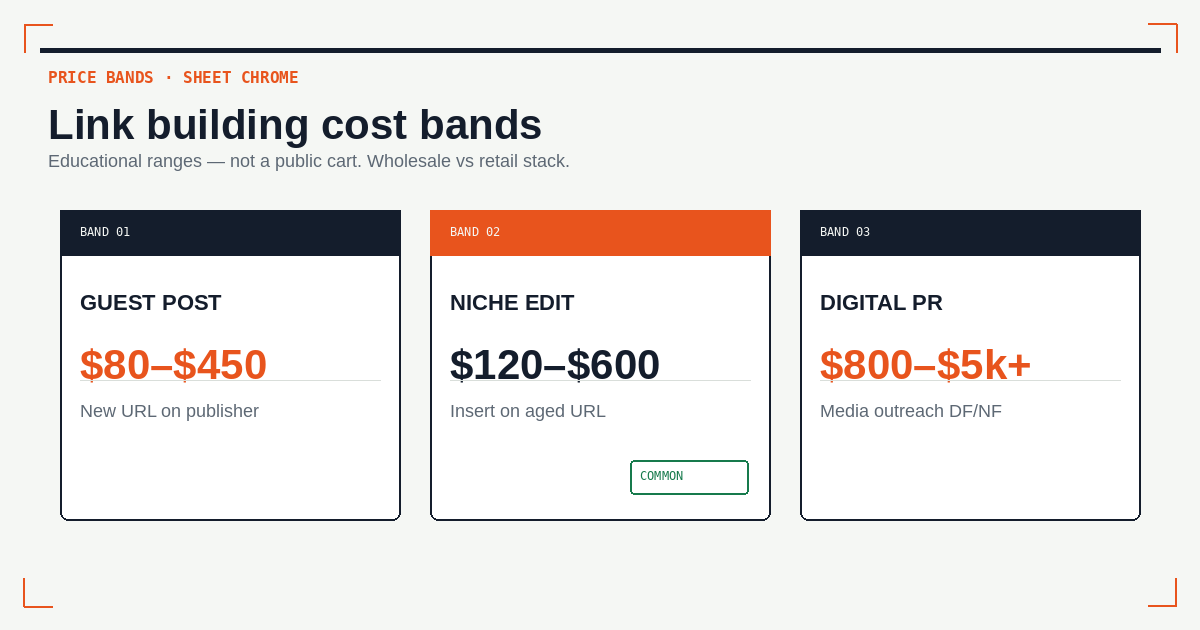
FIG. — Educational price bands / sheet chrome — not a public cart.
What Link Building Costs
Price follows placement type first, then publication quality. Domain Rating is how the market quotes; organic traffic and topical relevance are how you should actually buy. Ahrefs and Semrush measure those metrics. They do not certify that a backlink is “good.”
| Placement type | What the buyer is paying for | 2026 wholesale shape |
|---|---|---|
| Guest posts | Publisher fee + writing + outreach + QA | DR bands below; writing included on our sheet |
| Niche edits | Insertion into an existing indexed article | Typically 30–50% below a guest post at the same DR |
| Digital PR | Media outreach / syndication; often nofollow | Quoted per wire or product, follow labeled |
| White-label desk | The above, unbranded, tagged per client | Sheet rate, then volume terms |
Geo moves the quote even when DR looks identical. US English is the densest sheet. UK and Canada follow English calendars with local proof. Europe often prices in EUR on publisher carts — a different sourcing problem, not a third average.
Guest Post Pricing
A guest post is not “a link.” The stack is publisher fee, original writing, outreach to an editor who can refuse, QA, and fulfillment. That is why guest posting costs more than a raw URL. Mechanics: guest posting services.
| DR band | Wholesale range | Typical agency retail | Notes |
|---|---|---|---|
| DR 30–40 | $40–$80 | $100–$200 | Supporting links, velocity |
| DR 40–50 | $80–$150 | $200–$350 | Campaign workhorses |
| DR 50–60 | $150–$250 | $350–$500 | Solid mid-tier editorial |
| DR 60–70 | $250–$400 | $500–$800 | Flagship placements |
| DR 70+ | $400+ | $800+ | Tier-one editorial / PR value |
Price scales faster than DR: a DR 70 row is roughly 6× a DR 35 row, not 2×. Authority is scarce at the top. These are RankSupply sheet bands, not a promise every vendor in the SERP charges the same.
Niche Edit Pricing
Niche edits insert a sentence into an existing indexed article. You are not buying a writer’s day. Typical 2026 wholesale: $40–$100 at DR 40–60, $100–$250 at DR 60+. Live dates usually sit in the 3–7 day band after URL approval, versus 10–21 for guest posts. They are a different SKU, not “cheaper therefore worse.” Insertions into hacked pages or farms are a different product, and not one we sell. Niche edit services.
Digital PR Costs
Digital PR economics are media outreach and distribution, not a guest-post clone. Syndication is often nofollow. That can still be worth buying for brand and E-E-A-T; it is not a secret DR-90 DoFollow tap. We quote per wire or product and label follow status before you order. Product: Digital PR.
White-Label Link Building Costs
Wholesale versus retail is the agency job. You buy fulfillment at sheet rate. You bill a markup you can defend — typically about 2–2.5× when the report is unbranded. We do not publish named-client margins or supplier-by-supplier invoices. Commercial SKUs stay on white label link building; the desk that tags the book is SEO agency fulfillment.
What Changes the Price of a Backlink
Two “DR 55 guest posts” can be $90 and $220. The difference is almost never the number on the quote label.
Organic traffic
Ahrefs or Semrush estimates on the live host. A DR 60 domain with a couple of hundred monthly visits is usually a manufactured score.
Relevance
Legal and healthcare URLs are not fulfilled from a general business leftover bin. The host already has to cover the destination.
Geography
US, UK, and Canadian English inventory is not interchangeable. A Leeds desk and an Austin desk are different rows.
Publication quality
Named editors, a real rejection rate, and a readership that is not only other SEOs.
Placement type
Guest post, niche edit, and Digital PR are different products. Mixing them on one unlabeled invoice mis-briefs the client.
Content
Word count, original data, and expert quotes are line items on a guest post. A niche edit buys one sentence.
Link attributes
DoFollow, nofollow, and sponsored are different SKUs. Anchor constraints change difficulty too.
Warranty
Replace-or-refund is operations. “We guarantee rankings” is not a price feature.
The Cost Stack From Publisher to Client
The same host can appear through several hops. Each hop can add a marketplace fee or a reseller margin. That is why a cart screenshot will not match a white-label sheet, and why we do not yet publish marketplace-vs-marketplace price tables — we do not have enough proprietary transaction data to do that honestly.
Cheap vs Affordable Link Building
Affordable should mean an efficient supply chain: verified organic traffic, topical hosts, labeled follow status, approval before publish, a replacement rule. Cheap can mean weak traffic, irrelevant sites, farms, or no editorial control — or it can mean a fair niche edit. We will not write “links under $X are spam.” A $30 DR-60 guest post is information that DR was probably manufactured. Vetting: how to vet guest post sites.
Marketplace vs Managed Fulfillment Pricing
A cart row is publisher access. You own QA, invoices, and leak risk. Managed fulfillment adds sourcing and coordination. White-label fulfillment adds unbranded reports and no client contact. Digital PR is distribution, often nofollow. Do not compare a cart screenshot to a warrantied guest post as if they were one SKU. Directory research: marketplace directory. Buying models: best link building services.
Agency Margin Economics
The spread between wholesale and typical retail is the margin agencies live on. Volume (roughly 10–15% off sheet at 5–20 placements a month) changes both sides of the arithmetic. Price a monthly retainer off single-order rates and you will understate your own margin once the book is running. We do not publish named-agency spreadsheets.
Holding DR 50–60 constant, finance and legal run well above general business. A legal client’s $2,000 buys roughly half the placements a general-business $2,000 buys at the same quality bar. Price retainers accordingly — that is budgeting, not a traffic forecast.
Supported 2026 ranges and sample mixes
Three wholesale mixes we see agencies run per client. These are sheet mechanics, not a promise of rankings.
| Monthly wholesale | Typical mix | Links/mo | Often fits |
|---|---|---|---|
| $1,000 | 2 guest posts (DR 40–55) + 4 niche edits | 6 | Local & lead-gen |
| $2,500 | 4 guest posts (DR 50–65) + 6 niche edits | 10 | Competitive regional / SaaS |
| $5,000 | 6 guest posts (DR 55–70+) + 8 niche edits | 14 | National, legal, finance |
In-house is not free. A realistic loaded cost includes prospecting time, tools, writing, and the placement fee you negotiate anyway — often near ~$500 per DR 50+ link if you staff it in the US, versus ~$150 wholesale on a comparable sheet row. In-house wins when outreach is the firm’s core competency.
Link Building Costs FAQ
How much does link building cost per month?
There is no universal monthly fee. Agencies typically budget a mix of guest posts and niche edits per client. On RankSupply wholesale sheets in 2026, representative mixes run about $1,000, $2,500, or $5,000 per client-month depending on niche and DR mix — then the agency marks that up. Digital PR is usually a separate line.
How much does one backlink cost?
A range, not a sticker. RankSupply guest-post wholesale in 2026 runs roughly $40–$80 at DR 30–40 up to $400+ at DR 70+, with retail often about 2–2.5× that. Public 2026 guides quote professional acquisition from about $100 to $1,500+ per link.
Why are some backlinks more expensive than others?
Organic traffic, relevance, geography, publication quality, placement type, content, link attributes, and warranty. Two DR 55 guest posts can quote at very different prices.
How much should an SEO agency charge for link building?
Enough to cover wholesale, account time, and a margin you can defend — often about 2–2.5× on a white-label desk. Do not copy a marketplace cart row as retail. Packages are what RankSupply sells; this guide is how to think about cost.
Are cheap backlinks worth it?
Price alone does not determine quality. Cheap can mean weak traffic or a fair niche edit on a real page. Affordable should mean an efficient supply chain you can verify.
Do guest posts cost more than niche edits?
Usually yes. A guest post pays for a new article. A niche edit reuses an indexed URL, typically 30–50% below a guest post at the same DR, and goes live faster.
How much does Digital PR cost?
Quoted per wire or campaign, not as a guest-post clone. Syndication is often nofollow. Economics are media outreach and distribution.
Why does the same website have different prices on different marketplaces?
Publisher → marketplace → reseller → agency → client. Each hop can add a fee. RankSupply does not yet publish marketplace-vs-marketplace price tables.