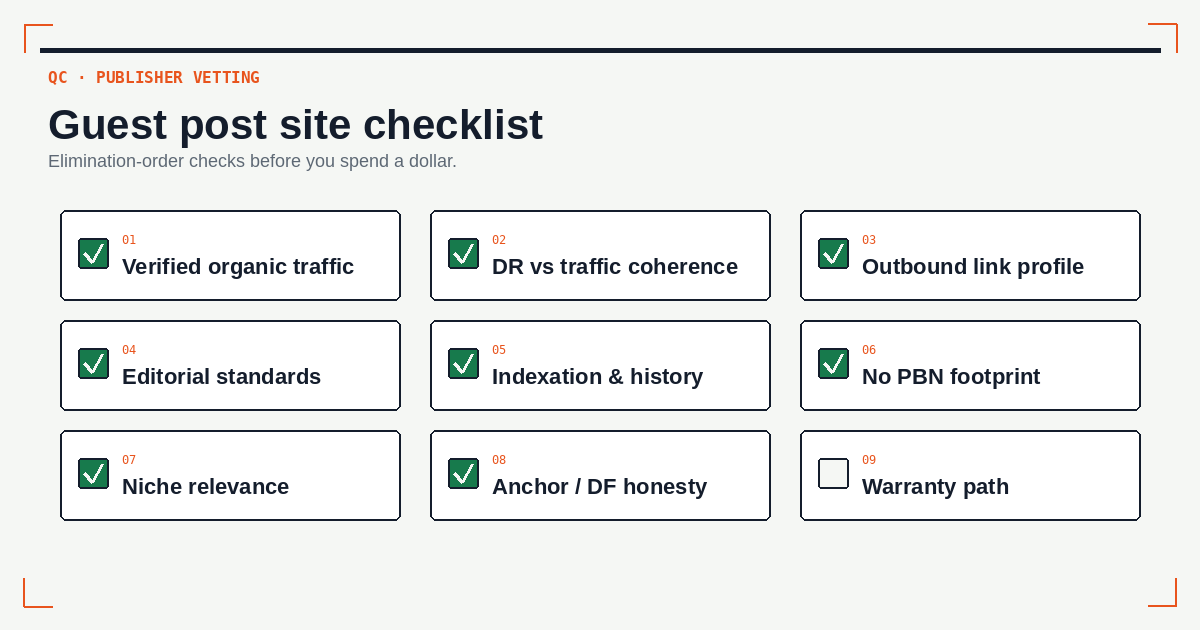
FIG. — Publisher vetting checklist chrome — elimination-order QC before spend.
Start with the only metric that can't be faked
1. Verified organic traffic. Open the domain in Ahrefs or Semrush and look at organic visits — not DR. A real publication has readers arriving from search, trending flat or up. A manufactured domain has authority metrics and a traffic graph scraping along zero. This single check eliminates more bad inventory than the other eight combined.
2. Traffic history, not just the current number. A cliff in the graph — traffic that fell 80% at a known Google update — means the site already took a penalty or quality hit. You'd be buying a link on a domain Google has already demoted.
The DR-vs-traffic quadrant
Plot any candidate site on two axes — authority (DR) and verified organic traffic — and the buying decision mostly makes itself:
Then check what the metrics can't tell you
3. The outbound link profile. Search the site for the money niches — casino, CBD, essay writing, payday loans. A "marketing blog" linking out to forty casinos has told you its business model, and Google reads the same signal.
4. Content quality on recent posts. Read three articles published this month. Unrelated topics side by side (crypto, plumbing, skincare) with thin AI filler and five outbound links each means the site publishes anything paid for.
5. Editorial friction. Real publications reject things. Named editors, submission guidelines with actual standards, and a pitch process are good signs; "send $40 and your doc" is the opposite.
6. Index status. A site: search should show the domain's recent posts in Google. Pages published a month ago that never got indexed mean Google has quality-filtered the site — your post would join them.
7. Topical fit. A legal client linked from a legal publication reads naturally to users and algorithms alike. The same link from a generic "business tips" blog is worth a fraction, whatever the DR. It's why our inventory is binned by niche rather than sold as one pool.
8. Traffic geography. For US clients, check where the visits come from. A site with a US-sounding name and 90% of its traffic from link-scheme geographies is renting its ranking from somewhere you don't want your client associated with.
9. The price sanity check. Cross-reference the quote against market benchmarks. Dramatically under market isn't a deal — it's the seller telling you which quadrant the site lives in.
Red flags at a glance
| Signal | What it looks like | What it means |
|---|---|---|
| DR-traffic gap | DR 60+, <500 organic visits/mo | Manufactured authority |
| Update cliff | Traffic −80% at a core update | Already demoted |
| Toxic outbound | Casino/pharma/essay links in content | Link farm economics |
| Topic soup | Crypto next to plumbing next to skincare | Publishes anything paid |
| No index | Recent posts absent from Google | Quality-filtered |
| Too cheap | "DR 60" at $30 | All of the above |
The tools that make these checks fast
None of the nine checks require expensive software, and doing them by hand the first few times builds the instinct to spot a bad domain in seconds later. The core toolkit in 2026:
- Ahrefs or Semrush for the traffic verification (checks 1, 2, and 8) and the outbound profile (check 3). Either one shows organic traffic history and referring domains; the free Ahrefs Website Authority Checker gives DR alone if you're spot-checking, but the traffic graph is what you're really after and needs a paid seat or a shared one.
- A plain Google site: search for index status (check 6) — no tool needed. site:example.com with a recent date filter tells you instantly whether Google is indexing new posts.
- Moz's free Link Explorer or the MozBar as a cross-reference on authority, since a big gap between Moz DA and Ahrefs DR on the same domain is itself a manipulation signal.
- Your own eyes for content quality and editorial friction (checks 4 and 5). No metric replaces reading three recent articles and looking for a real submissions page with a named editor.
Run in the order above, the traffic and index checks kill most bad candidates in under five minutes, so you only spend real time reading content on domains that already passed the cheap filters.
The 2026 wrinkle: AI-generated publisher content
The newest failure mode isn't a link farm — it's a legitimate-looking publication that quietly switched to mass-produced AI content. Since Google's guidance shifted to judging content by quality and usefulness rather than how it was produced, plenty of once-real sites now pump out dozens of thin AI articles a day to keep publishing volume up for paid placements. The metrics can still look fine for a while: the domain has genuine historical traffic and a respectable DR from its earlier life. What gives it away is the recent-content check applied harder — open the last week of posts and look for the tells of unedited generation: near-identical article structures, confidently generic advice with no first-hand detail, no author who exists anywhere else online, and publishing velocity no human newsroom could sustain. A March 2024-style helpful-content demotion tends to follow these sites within a couple of updates, taking your link's value down with the traffic. When traffic is still healthy but the recent content reads like it was generated in bulk, treat it as a domain on borrowed time, not a safe buy.
The takeaway
Vetting is thirty minutes per domain done properly — which is exactly why most sellers hope you won't. Run the traffic check first, the quadrant test second, and walk away from anything in the bottom-right. Or skip the thirty minutes: every domain on our inventory sheet has already cleared all nine checks, with the Ahrefs numbers printed next to the price so you can verify rather than trust.