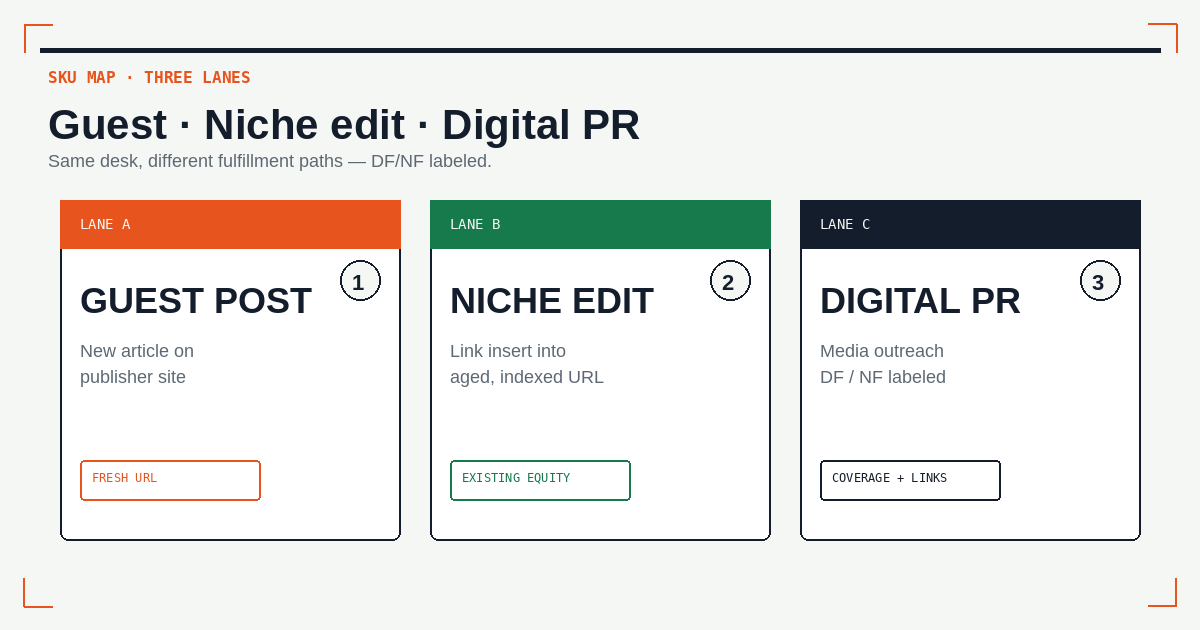
FIG. — Three SKU lanes on the same desk: new article, aged-URL insert, media outreach with DF/NF labeled.
Agencies do not buy “links” as a single SKU. They buy fulfillment paths — and confusing those paths is how briefs get misfired, margins get mispriced, and client reports end up explaining the wrong thing. This guide separates the three lanes we fulfill most often for US, UK, and Canadian SEO agencies: guest posts, niche edits, and Digital PR.
No invented rankings. No ROI theater. Just what each SKU actually is on the wire, when it fits a client brief, and how RankSupply labels follow attributes so you can resell without cleaning up someone else’s ambiguity. Operator inventory for context: 100k+ publishers on the sheet, and roughly 500 SaaS niche-edit options where topical fit matters.
The one-line definitions
- Guest post = a new article published on a publisher site, with your (or your client’s) link inside editorial copy. Fresh URL. See guest posting service.
- Niche edit = a link inserted into an existing, aged, already-indexed URL — not a new post. The page already has history. See niche edits.
- Digital PR = media outreach that can land coverage, mentions, and links — with DoFollow (DF) and NoFollow (NF) labeled honestly on delivery. See Digital PR.
White-label wrapping sits on top of all three: we fulfill under your brand, you approve before publish, you invoice the client. That model is documented on white-label link building.
Guest posts: new article, new URL
A guest post is the most familiar lane. The publisher accepts (or commissions) a new piece; it goes live on a fresh permalink; the link sits in context you control more tightly than a mid-article insert on someone else’s old post. Agencies use this when they need topical relevance, a readable byline story, or a volume of placements that still look like content — not a quiet edit nobody would notice.
What you should demand on delivery: live URL, follow attribute stated (DF or NF), surrounding copy that reads like a human wrote it, and a replacement path if the link drops. What you should not invent for the client: that one guest post “moved them to position three.” Guest posts are inventory units inside a broader SEO program. Price and quality bands vary widely; our educational ranges live in the 2026 cost guide, and packages stay on the packages page — this post is about SKU shape, not a cart.
Operationally, guest posts are also where vetting bites hardest. A new URL on a manufactured-DR domain is still a new URL on a bad host. Run the checks in how to vet guest post sites before you approve a host for a client who trusts your judgment.
Niche edits: insert into an aged URL
A niche edit (also called a link insert) does not create a new article. The supplier negotiates an editorial insert into a page that already exists — ideally aged, indexed, and still earning organic traffic. The bet is page-level equity and topical fit, not “we published something new this week.”
That difference matters for briefs. If a client wants “more content mentioning us,” a guest post is the clearer story. If they want a link from a URL that already ranks for a related query, a niche edit is the clearer SKU — provided the host is real and the insert is editorial, not spam bolted onto a footer farm.
Our SaaS lane is a good example of why niche specificity matters: roughly 500 SaaS niche-edit options on the sheet means you can ask for topical adjacency instead of a generic “DR 50 insert.” Still: niche edits are not magic. An aged URL on a declining domain is aged junk. Traffic history and outbound profile still decide whether the insert is worth your client’s money.
Reporting tip for agencies: show the target URL that already existed, the live link, and the follow attribute. Clients understand “we earned a mention inside an existing article” when you say it plainly. They get confused when niche edits are sold as “guest posts” with a different invoice line.
Digital PR: outreach with DF/NF labeled
Digital PR is outreach to journalists, editors, and publications where the outcome may be a story, a resource mention, a data pickup — and sometimes a link. It is slower, less cart-like, and more variable than guest posts or niche edits. It is also where dishonest sellers hide: bundling guaranteed “DR 90 DoFollow” language onto placements that are actually sponsored NF, or worse, unlabeled.
RankSupply’s rule on this lane is boring on purpose: label DF and NF on delivery. If a placement is NoFollow, the report says NoFollow. If it is DoFollow, the report says DoFollow. Agencies reselling white-label work cannot afford to discover the attribute from a client’s SEO tool three weeks later.
Use Digital PR when the brief is reputation, narrative, or category authority — not when the brief is “ten DF links by Friday.” Mix it with guest posts and niche edits when a program needs both coverage and controlled placement volume. The service page is Digital PR; fulfillment still runs through the same white-label desk.
Side-by-side: how to brief each SKU
| Dimension | Guest post | Niche edit | Digital PR |
|---|---|---|---|
| What ships | New article + link | Insert on aged URL | Coverage / mention / link |
| URL age | New permalink | Existing page | Publisher-controlled |
| Speed (typical) | Faster than DPR | Often mid | Slowest / variable |
| Follow attribute | Must be stated | Must be stated | DF/NF labeled — non-negotiable |
| Best brief fit | Topical content + link | Page-level equity insert | Narrative / media |
| Main failure mode | Bad host, thin AI post | Declining aged URL | Unlabeled NF sold as DF |
None of these rows promise rankings. They describe fulfillment mechanics so your strategist and your fulfillment desk use the same vocabulary.
How agencies usually combine the three
Healthy programs rarely pick only one lane. A common pattern: niche edits for money-page adjacency where aged URLs exist; guest posts for controlled topical coverage and volume; Digital PR for moments when the client has data, a launch, or a story worth pitching. The mix is a strategy call — RankSupply’s job as a white-label fulfillment desk is to execute the mix you approve, not invent the mix for you after the fact.
Margin math still works the same way across SKUs: wholesale in, client price out, your brand on the report. Per-tier numbers and educational bands are in the cost benchmarks and on packages. What changes per SKU is the story you tell the client about what arrived — new URL, aged insert, or media coverage — not a fantasy multiplier on traffic.
What to put in the contract (any lane)
- Pre-publish approval on host, anchor, and draft/insert copy.
- Follow attribute on the report — DF or NF, no “assumed DoFollow.”
- Replace-or-refund warranty if the link drops or loses the agreed follow status.
- No client contact from the supplier — your book of business stays yours.
- Inventory transparency — named domains and metrics you can verify, not “trust the network.”
Those controls are why white-label works when it works. They are also why we refuse to sell unlabeled links as a product.
Choosing a lane without overselling
Ask three questions before you pick SKUs for a client month:
- Do we need a new URL or an existing one? New → guest post. Existing equity → niche edit.
- Is the goal coverage or controlled placement? Coverage → Digital PR. Controlled placement → guest/niche.
- Can we label follow status without embarrassment? If a seller cannot answer DF vs NF before invoice, walk.
If you want the sheet instead of the theory — 100k+ publisher options, SaaS niche-edit depth, wholesale rates — request a quote or start from the service pages linked above. We will not invent ranking outcomes to close the order.
FAQ
Is a niche edit “better” than a guest post?
Not inherently. A niche edit can sit on stronger page-level history; a guest post gives you a new URL and clearer content control. Quality of host and honesty of follow attribute beat the SKU label.
Do you guarantee DoFollow on Digital PR?
No blanket guarantee. We label DF/NF as delivered. Selling every DPR hit as DoFollow is how agencies lose trust.
Can these ship white-label?
Yes. All three lanes fulfill under white-label link building — your brand, your approvals, our desk.