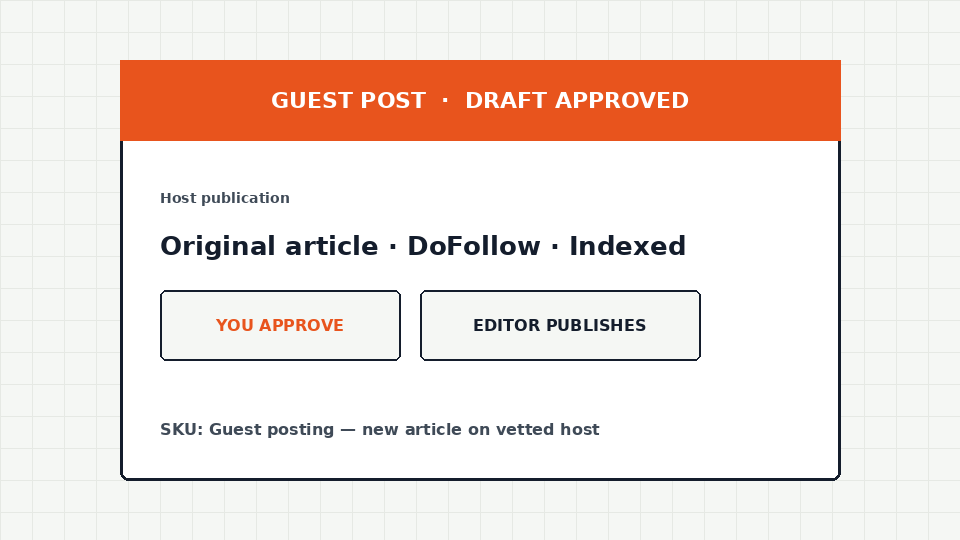
Original articles placed on vetted legal, healthcare, SaaS, finance, and news publications — every domain checked for real organic traffic in Ahrefs, not just a DR number. Delivered DoFollow, indexed, and warrantied.
Pricing scales with the publication's Domain Rating and traffic, not with word count. These are representative sheet-rate midpoints — the full sheet prices every domain individually.
Most guest post marketplaces sell DR numbers. DR is trivial to inflate — traffic isn't. Every domain on our sheet clears four checks before it's stocked.
Ahrefs-verified organic visits, trending flat or up. Domains coasting on expired-domain authority with no readers don't get stocked.
Named editors, actual review, rejection rates above zero. If a site publishes anything for anyone, the link is worth what that implies.
We check what a site links out to. Domains linking into casino/pharma/essay-mill clusters are excluded regardless of metrics.
Legal links from legal publications, health links from health publications. Topical match is the filter, not an upsell.
Choose domains from the inventory sheet, or send targets and let us match against stock. We confirm acceptance before invoicing.
Our writers produce the article; you approve topic, anchor, and full draft. Revisions included.
Published DoFollow, submitted for indexing. You get the live URL plus a report with domain metrics.
Link drops or loses DoFollow? Replacement of equal-or-better metrics, or a refund.
A representative scenario built from real sheet mechanics — not a named client. It shows how a typical order moves from brief to live links.
A US agency resells for a project-management SaaS client targeting mid-competition commercial keywords. They need 6 DoFollow guest posts over a quarter — topical, real-traffic domains, no marketplace filler — delivered under the agency's own brand.
The term "guest posting" covers everything from genuine contributed editorial to spam. Where a placement sits on that spectrum is what decides whether it helps or hurts.
Guest posting started as a straightforward exchange: a writer contributes an original article to a publication, the publication gets free quality content, and the writer earns a byline and usually a contextual link back to their site. That's how contributor programs at places like Forbes, Entrepreneur, and thousands of smaller trade publications have always worked. The practice only became controversial when link sellers industrialized it — spinning low-value articles across networks of sites that exist only to host paid links. Google's response, going back to the 2014 crackdown that Matt Cutts announced and every spam update since, has been to devalue the footprint, not the format. A contributed article on a real publication with real readers is still exactly as legitimate as it ever was.
The line we hold is simple: every publication on our sheet is a site a human would actually read. It has organic search traffic you can verify in Ahrefs or Semrush, a named editor who can reject a pitch, and an audience that isn't just other SEOs. When an article runs there, the link inside it is a byproduct of a real editorial placement — the same thing a PR agency earns for a client, priced wholesale. That distinction is not a marketing line; it's the difference between a link that compounds and one that becomes a liability in the next core update.
What that means in practice: we turn down placement requests on domains that fail the traffic or outbound-profile check, even when a client asks for them by name. A DR 60 domain with no organic traffic and a footer full of casino links is worth less than a DR 35 trade blog that ranks for its niche — and we price and stock accordingly. It's the same standard covered in how to vet guest post sites, applied before anything reaches the sheet.
Our editorial team writes original articles matched to each publication's style, included in the placement price. You approve every draft before it's pitched, and revisions are included until it matches your brief.
Paying a third party purely to pass PageRank is what Google's link spam policy targets. What we sell is a content placement service — the writing, outreach, and editorial work that gets a genuine article published on a relevant, real-traffic publication. The link is a byproduct of that placement, and we label follow status honestly. That's the same activity a PR or content-marketing agency performs; the guideline issue is spun content on link-network sites, which is exactly what our vetting excludes.
A guest post is a brand-new article written and published for the placement; a niche edit inserts your link into an existing, already-indexed article on the publisher's site. Guest posts take longer and cost more but give you a full contextual article and a fresh URL; niche edits are faster and cheaper because the page already exists and often already ranks. Most campaigns use both.
Yes — every placement is delivered DoFollow and covered by the warranty against losing that attribute. If a publisher later NoFollows the link, that's a warranty claim: replacement or refund.
Typically 10–21 days from draft approval, depending on the publication's editorial calendar. Niche edits are faster if timeline is the constraint — see niche edits.
Yes. The full inventory sheet — every domain, DR, traffic, niche, and price — goes out on request to agencies. Email us and it's in your inbox same day.
The full inventory sheet: 300+ publications with Ahrefs-verified metrics and wholesale pricing.