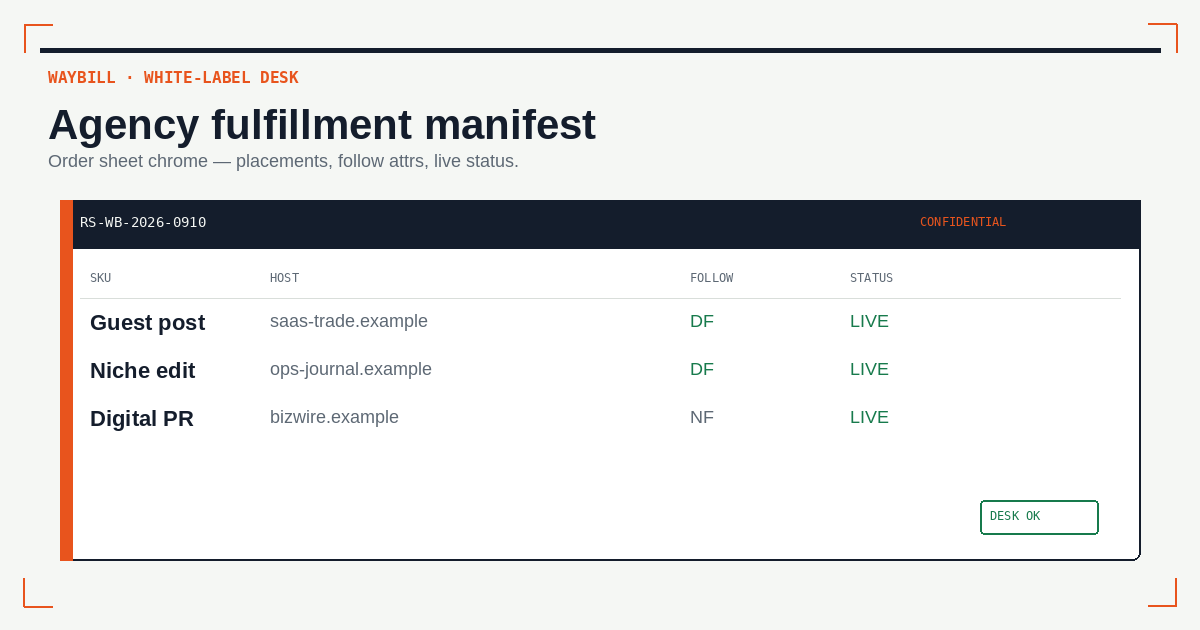
FIG. — Waybill / white-label desk chrome — placements with follow attrs labeled.
What "white-label" actually means here
In link building, white-label means the supplier's work product — placements, drafts, and reports — is delivered carrying your agency's brand, priced at wholesale so you can resell at margin. Your client signs with you, hears from you, and reads reports with your logo. The supplier is invisible by design and, in a serious arrangement, by contract.
It is not the same thing as referring a client to a vendor (you lose the relationship) or reselling a marketplace login (you lose quality control). The defining features are wholesale pricing, your brand on deliverables, and your approval before anything ships.
The workflow, end to end
The critical structural detail: approval sits with you, twice — once on the placement (site, topic, anchor) and once on the draft. A supplier who won't give you both gates is asking you to stake your client relationship on their judgment.
The margin math
US agencies typically bill clients 2–2.5× wholesale for equivalent placements. On a modest 10-placement month at an average $150 wholesale, that's $1,500 in cost against $3,000–$3,750 billed — margin comparable to your strategy retainer, on work you didn't staff. We break the per-tier numbers down with charts on the white-label service page and in the 2026 cost benchmarks.
What to demand from any white-label supplier
- Transparent inventory. A sheet with named domains, DR, and verified traffic — before you pay. "Trust our network" is not a site list.
- Pre-publish approval. Both gates: placement and draft. Non-negotiable.
- A link warranty. Replacement or refund if a link drops or loses DoFollow. This moves the durability risk onto the supplier, where it belongs.
- A no-client-contact clause. Contractual, not verbal. Your book of business is the asset you're protecting.
- White-label reporting you'd actually forward. Live URLs, metrics, your logo, no supplier fingerprints.
- Wholesale terms that scale. Volume discounts and Net-15/Net-30 invoicing so your cash cycle works.
The risks, and how to contract them away
Quality risk — the supplier places your client on a manufactured-DR domain and the "win" evaporates at the next spam update. Control: vet the inventory yourself using the checks in our vetting guide, and spot-check placements monthly.
Disclosure risk — the supplier contacts your client, or a report leaks their brand. Control: the no-contact clause plus reports you generate or re-brand yourself.
Concentration risk — all your clients' links come from one pool, creating footprint overlap. Control: a supplier with genuinely deep inventory (hundreds of domains across niches), and per-client placement history so the same client never doubles up.
When white-label is the wrong call
If link building is your agency's differentiator — you sell digital PR as the product — build in-house; the capability is your moat. White-label fits when links are one line item in a broader engagement you'd rather not staff an outreach team for. Most full-service agencies are in the second camp, which is why most of our volume is agency resale.
Vetting a supplier before you commit a client to them
Once your client's rankings depend on a supplier's placements, switching mid-campaign is painful — so the vetting happens before the first order, not after a bad one. A short due-diligence pass separates operators from resellers-of-resellers: ask for the actual inventory sheet with named domains and request that they pull live Ahrefs traffic on three of them while you watch, so you know the metrics are current rather than screenshots from 2023. Order a single test placement at sheet rate before signing any volume commitment, and check the delivered link yourself — is it indexed, is it genuinely DoFollow, does the surrounding article read like something a human wrote. Confirm the warranty and no-contact terms are in writing, not just on a sales call. A supplier confident in their work will pass all of this without friction; one that stalls on any of it is telling you what the client relationship would eventually feel like.
How to price it to your client
The margin only materializes if you price the client side deliberately, and this is where a lot of agencies leave money on the table or, worse, undercut their own positioning. Three models dominate in 2026:
- Per-link markup. The simplest: take the wholesale rate, apply a 2–2.5× multiplier, quote per placement. Transparent and easy to scale, but it invites clients to price-shop you against retail vendors, and it caps your value at "link reseller."
- Bundled into a retainer. Links are one line inside a broader SEO engagement — strategy, on-page, content, and off-page as a single monthly figure. The client never sees a per-link number, which protects your margin and reframes you as the strategist rather than a middleman. This is the model we see work best for full-service shops.
- Tiered packages. Bronze/silver/gold monthly link volumes at fixed prices, mirroring the structure on our own packages page. Predictable for both sides and easy to upsell, though it demands you forecast volume accurately enough not to erode the margin on the top tier.
Whichever you choose, the principle holds: the client is buying an outcome and your judgment, not a commodity link. Price against the value of ranking their money pages, not against the wholesale sheet — the spread is your compensation for owning the strategy, the QA, and the relationship the supplier never touches.
Communicating results without overpromising
The fastest way to lose a white-label client is to promise rankings a link can't guarantee. Links are one input into an algorithm you don't control, so the reporting that keeps clients long-term focuses on what actually happened — placements delivered, live URLs, DR and traffic of each publication, follow status — rather than implying every link caused a ranking jump. When a client asks "did this work," the honest, retention-building answer ties the link campaign to leading indicators (referring domains gained, keyword movement over a quarter, not a week) and sets expectations that link equity compounds over months. A supplier that labels follow status honestly and warranties placements gives you the raw material for that kind of straight reporting; one that oversells "DR 90 DoFollow" links leaves you to either pass on a lie or absorb the gap. That honesty is also, not coincidentally, the same standard Google's own guidance rewards — demonstrable, verifiable authority over inflated claims.
The takeaway
White-label link building works when the incentives are written down: wholesale pricing, double approval gates, a warranty, and a no-contact clause. Get those four in writing and the model gives you a fulfillment arm at margin. Get zero of them and you've just bought links with extra steps. If you want to see our version of the paperwork, ask for the inventory sheet and a sample report.