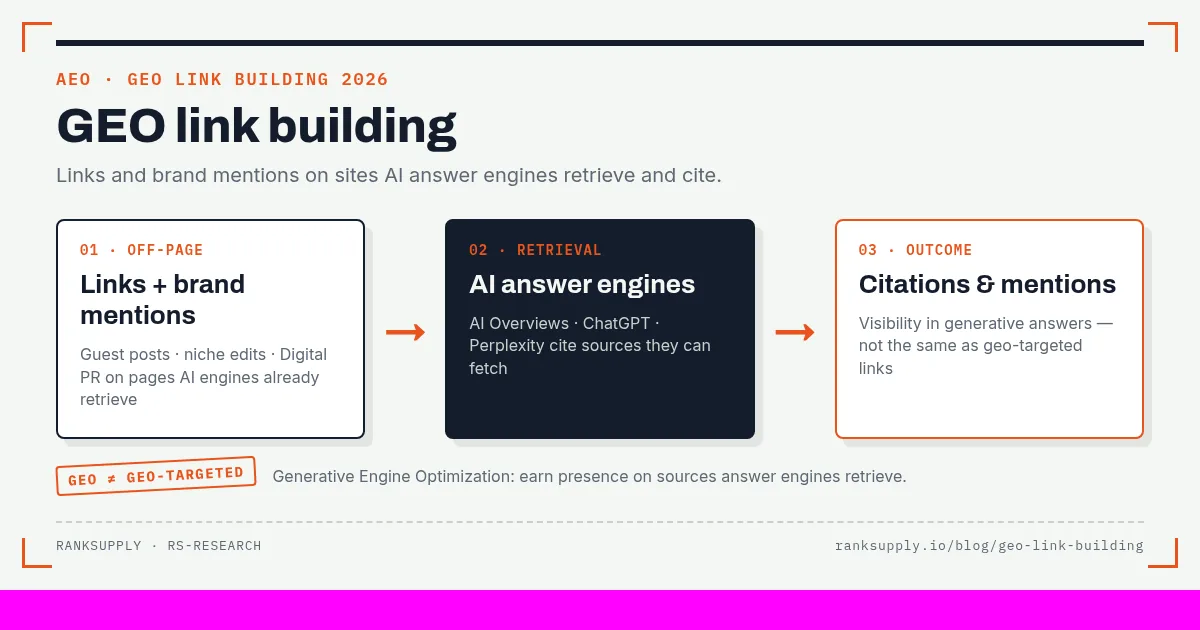
FIG. — GEO link building flow: off-page links and mentions → AI retrieval → citations in generative answers.
GEO link building means earning links and brand mentions on sites that AI answer engines retrieve and cite, which is different from geo-targeted link building. Agencies asking about link building for AI search are usually looking for the same thing under a newer label: presence on sources ChatGPT, Perplexity, and Google AI Overviews already trust enough to quote. This page separates what public data supports from what is still guesswork, and what a white-label desk should put in client reports.
Do backlinks still matter in 2026?
Yes — for ranking, for crawl discovery, and for putting a URL into the candidate set generative systems draw from. They are no longer a complete answer to “how do we show up in AI answers.”
Pew Research Center reported on July 22, 2025 that Google users were less likely to click traditional results when an AI summary appeared: 8% clicked a traditional result with a summary versus 15% without, and only about 1% clicked a link inside the AI summary, based on a survey of 900 U.S. adults in March 2025 (Pew Research). That does not mean links stopped mattering for SEO. It means a larger share of attention stops on the generative layer, so agencies need a plan for being cited there — not only for ranking below it.
Classic organic still pays the bills for most agency clients. Backlinks remain one of the inputs search engines use to decide which pages earn that organic slot. GEO work sits on top of that foundation; it does not replace it.
How AI Overviews, ChatGPT and Perplexity pick sources
None of the major answer engines publish a full ranking formula. What we can observe is which URLs they cite, and how those URLs relate to classic SERPs.
Ahrefs’ March 2, 2026 update, covering 863,000 SERPs, found that 37.9% of URLs cited in AI Overviews also appeared in the top 10 organic results for the same query, while 31.0% of cited URLs were not in the top 100 (Ahrefs, March 2026). Ranking in the top 10 helps; it is not required. Pages can be cited from deeper organic positions or from sources that answer engines treat as authoritative for the sub-question they fan out to.
ChatGPT and Perplexity are retrieval-augmented in different ways, but both lean on pages that are publicly crawlable, clearly written, and frequently referenced elsewhere. In practice, that favors:
- Indexed pages with a clear answer near the top (definition or direct claim first).
- Sources that appear in news, research, and other high-trust corpora — not only in link marketplaces.
- Brand names that show up as plain-text mentions even when no follow link is present.
For agencies, the operational takeaway is narrow: build and earn pages that are eligible for retrieval, then earn mentions on pages that already are.
Links vs brand mentions
Ahrefs studied 75,000 brands (published May 26, 2025) and reported rank correlations with AI Overview visibility of 0.664 for web mentions, 0.326 for Domain Rating, and 0.218 for backlinks. The same post cautioned that correlation is not causation (Ahrefs, May 2025).

Reading that chart carefully matters. A stronger correlation for mentions does not mean “stop buying links.” It means a program that only counts dofollow URLs, and never tracks unlinked brand mentions or news name-checks, is measuring the weaker of two related signals for generative visibility. Links help a page get into the pool; mentions help a brand get named when the model composes an answer.
Which placements help: guest posts vs niche edits vs Digital PR
Placement type changes what you earn:
- Guest posts create a new topical URL. When the host has real traffic and editorial standards, that URL can rank for supporting queries and become a citation candidate in its own right. Brand name in the byline or body adds a mention on top of the link.
- Niche edits insert a link (and often a short brand phrase) into an aged page that already has traffic and referring domains. For GEO, that aged URL is often a stronger retrieval candidate than a brand-new post on a thin host. RankSupply keeps roughly 500 SaaS niche edits in inventory for agencies that need topical inserts without a full article build.
- Digital PR is the lane most aligned with the Ahrefs mention finding. News and syndication create brand name appearances — sometimes with a link, sometimes without — on domains answer engines already crawl heavily.
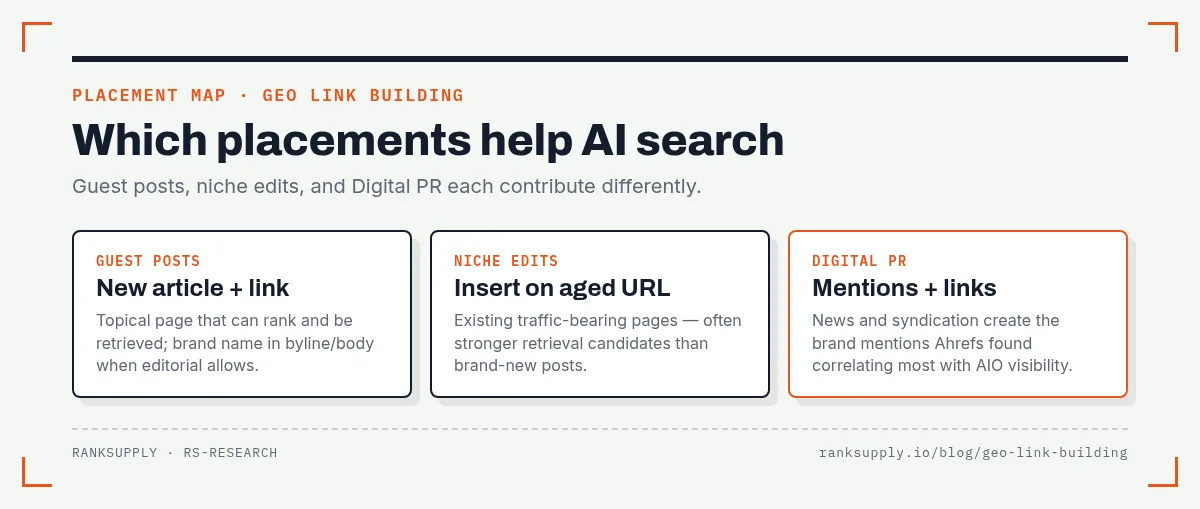
Agencies comparing SKUs should read RankSupply’s guest posts vs niche edits vs Digital PR map before reallocating budget. For fulfillment under the agency brand, the same lanes ship through white-label link building with unbranded reporting.
Why DR alone misleads
Buying “DR 50+” as a proxy for AI-citation worth is a weak filter. RankSupply’s guest post pricing 2026 study of 69,597 publisher listings found:
- 50.7% of 69,384 sites with traffic data report fewer than 1,000 monthly organic visits.
- 19.4% report fewer than 100 visits; 18.0% report 10,000 or more.
- 30.4% of 17,442 DR 50+ sites report fewer than 1,000 monthly visits.
- News and local news make up 22.8% of listings; median guest post list price is $336.

AI engines retrieve pages with real reach and clear topical authority. A manufactured-DR listing that sells cheaply is usually a poor citation candidate even when the spreadsheet looks fine. That is the same filter RankSupply applies across its 100,000+ publisher network before a domain reaches an agency sheet.
What agencies should report to clients
Client reports that only list live URLs and Domain Rating miss the GEO story. A useful monthly pack for AI-search work includes:
- Placement inventory — live URL, target URL, anchor, follow attribute (DF/NF), publish date, and SKU (guest post / niche edit / Digital PR).
- Host quality — verified organic traffic band and topical fit, not DR alone.
- Mention log — brand name appearances with and without a link, especially from news and Digital PR.
- Citation spot-checks — dated notes on whether the brand or URL appears in AI Overviews, ChatGPT, or Perplexity for a fixed set of client prompts (manual or tool-assisted; label the method).
- Organic baseline — classic rankings and clicks still matter; Pew’s click-share shift does not erase them.
Do not promise AI Overview inclusion. Report observations with dates. Correlation studies are directional evidence, not a guarantee that one more guest post will trigger a citation.
FAQ
What is GEO link building?
GEO link building means earning links and brand mentions on sites that AI answer engines retrieve and cite, which is different from geo-targeted link building (links aimed at a city or region). The goal is presence on sources generative engines already trust enough to quote.
Do backlinks still matter in 2026?
Yes, for classic ranking and for putting a URL into the retrieval pool AI systems draw from. Ahrefs’ May 2025 study of 75,000 brands found backlinks correlated less strongly with AI Overview visibility (0.218) than web mentions (0.664) or Domain Rating (0.326), and noted that correlation is not causation. Links remain necessary; they are not the whole story for generative visibility.
Do brand mentions matter more than links for AI Overviews?
In Ahrefs’ May 2025 analysis of 75,000 brands, web mentions had a stronger rank correlation with AI Overview visibility (0.664) than backlinks (0.218) or Domain Rating (0.326). Ahrefs cautioned that correlation does not establish causation. Mentions help visibility; links still help a page get crawled, indexed, and ranked into the candidate set.
How do AI Overviews pick sources?
Ahrefs’ March 2026 study of 863,000 SERPs found that 37.9% of URLs cited in AI Overviews also appeared in the top 10 organic results for the same query, while 31.0% of cited URLs were not in the top 100. Ranking helps, but it is not required. Pew Research (July 22, 2025) found users click traditional results less often when an AI summary appears (8% vs 15% without), and only about 1% click links inside the AI summary, based on 900 U.S. adults in March 2025.
Why is Domain Rating alone a weak GEO signal?
In RankSupply’s guest post pricing 2026 study of 69,597 listings, 30.4% of 17,442 DR 50+ sites report fewer than 1,000 monthly organic visits, and 50.7% of 69,384 sites with traffic data report under 1,000 visits. Authority metrics without readers are a weak candidate for AI citation.
Which placements help GEO: guest posts, niche edits, or Digital PR?
Guest posts create a new topical URL that can rank and be retrieved. Niche edits place a link (and often a brand phrase) on an aged, traffic-bearing page. Digital PR and news placements are the strongest path to the brand mentions that correlate with AI Overview visibility. Agencies usually need a mix; see RankSupply’s comparison of guest posts vs niche edits vs Digital PR.
GEO link building is link building plus mention acquisition, aimed at the sources answer engines already retrieve. Keep measuring organic. Add mention and citation checks. Prefer traffic-bearing hosts over DR theater. That is the practical bar for agencies shipping white-label work in 2026.