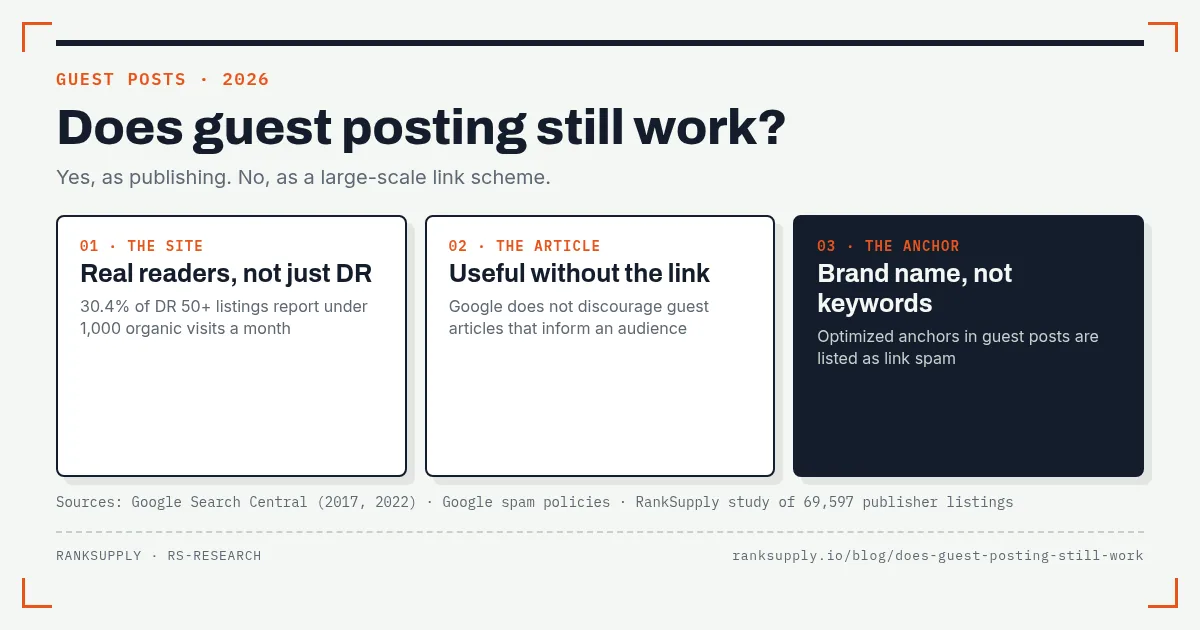
FIG. — Guest posting works or fails on the site, the article and the anchor, not on the tactic’s name.
Does guest posting still work is one of the most common questions agencies get from clients, usually after reading that “guest posting is dead.” The tactic is not dead, but the version that worked in 2012, many near-identical articles with exact-match anchors, is the version Google now ignores or penalizes. This guide sets out what Google’s own documents say, what RankSupply’s study of 69,597 publisher listings shows about site quality, and what a guest post that still works looks like. Every source was checked on 2 November 2026.
What does Google say about guest posting?
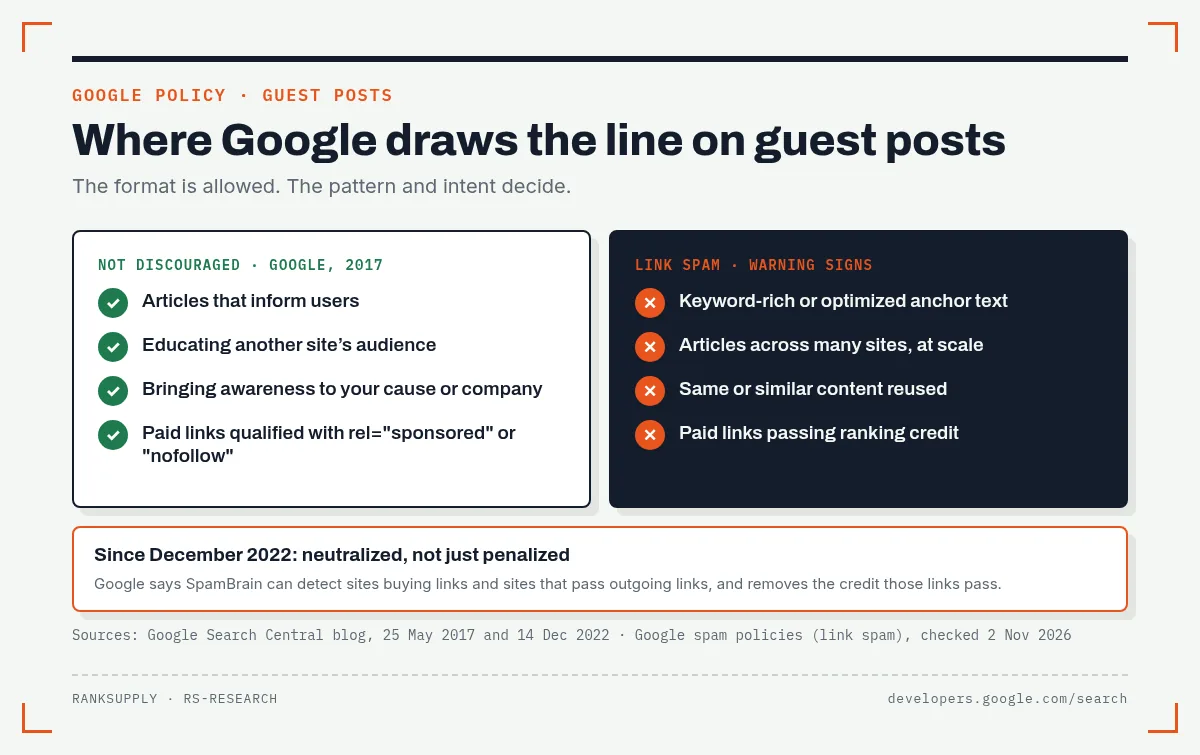
Google does not ban guest posting; it targets guest posts written mainly to build links. In a 2017 Search Central post, Google’s webspam team wrote that it “does not discourage these types of articles in the cases when they inform users, educate another site’s audience or bring awareness to your cause or company” (Google Search Central, May 2017). The same post lists four warning signs, when taken to an extreme:
- Stuffing keyword-rich links to your site into the articles.
- Publishing articles across many different sites, or many articles on a few large sites.
- Using writers who don’t know the topic.
- Using the same or similar content across the articles.
Google’s current spam policies are more specific about money. Under link spam, they list “links with optimized anchor text in articles, guest posts, or press releases distributed on other sites,” and advertorials where payment is received for articles with links that pass ranking credit. The policy also says buying and selling links “is a normal part of the economy of the web” and is not a violation when the links are qualified with rel="nofollow" or rel="sponsored" (Google spam policies).
Why do some guest posts stop working?
Many guest-post links stop working because Google’s systems discount them, not because a site gets a penalty. In its December 2022 link spam update, Google said its AI-based system SpamBrain “can now detect both sites buying links, and sites used for the purpose of passing outgoing links,” and that the update would “neutralize the impact of unnatural links,” so any credit they passed is lost (Google Search Central, December 2022).
That changes how agencies should read a flat result. A guest post on a site that exists mostly to sell posts can go live, show in a backlink tool and still pass nothing. The risk is less often a manual action and more often a budget that buys links Google has already decided to ignore.
Does guest posting still work for SEO rankings?
Guest posting can still help rankings when the host site has real organic traffic, because organic traffic is the clearest outside sign that Google already ranks the site. Domain Rating alone does not show this. In RankSupply’s guest post pricing 2026 study of 69,597 publisher listings, 30.4% of sites with DR 50 or higher reported fewer than 1,000 monthly organic visits, and 12.1% reported fewer than 100.
The market already prices this in. Across the same listings, organic traffic correlated with price at 0.361 (Spearman), referring domains at 0.344 and DR at only 0.204. DR 50+ sites with under 1,000 visits had a median list price of $209, against $903 for DR 50+ sites with 10,000 or more visits.
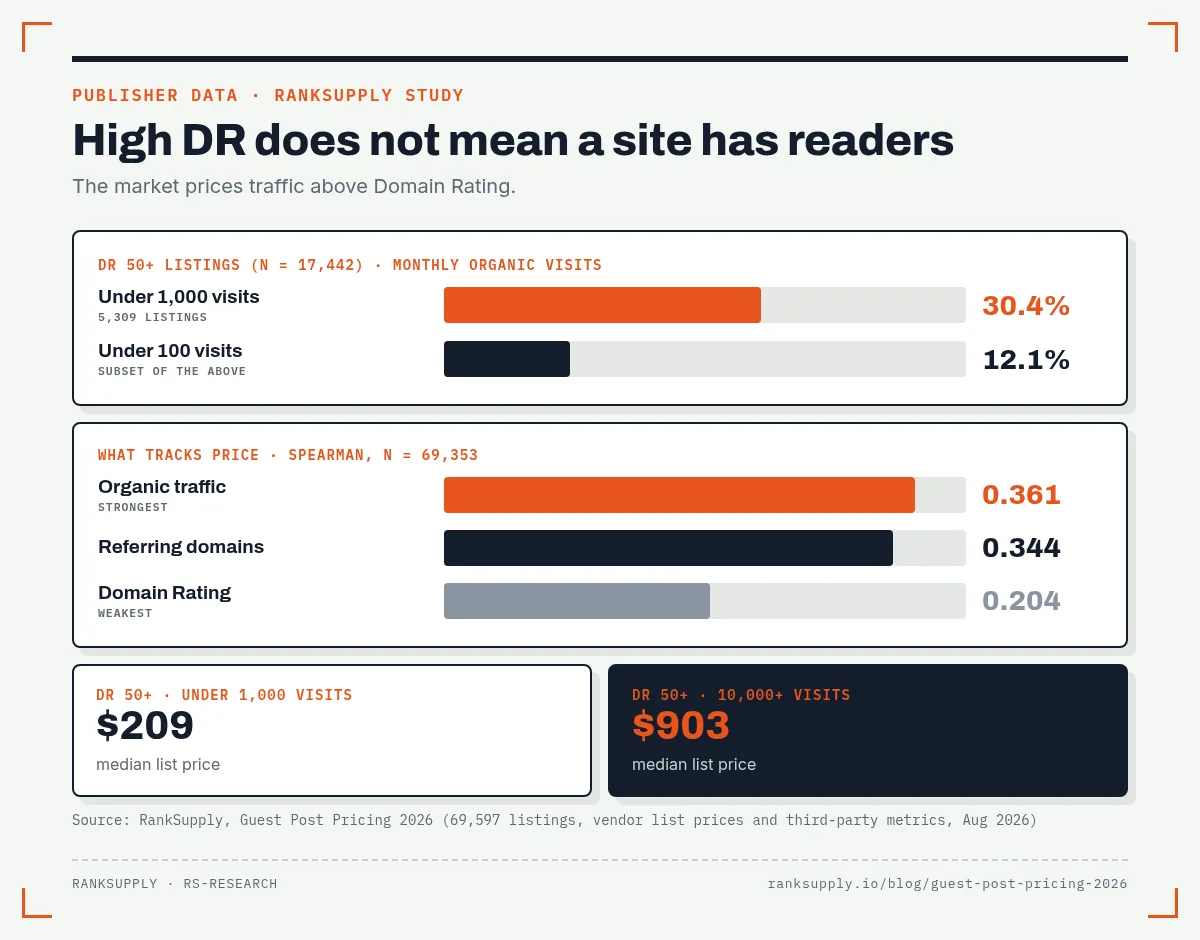
These are third-party site-level estimates recorded by vendors, so treat them as a filter, not proof. Our checklist for vetting guest post sites covers the manual checks that metrics miss, such as traffic trend, topic fit and the site’s outbound link profile.
Does guest posting help with AI search?
Guest posts can help with AI search when they mention the brand in a relevant article, because brand mentions track AI visibility more closely than link counts. In Ahrefs’ study of 75,000 brands, branded web mentions correlated with brand visibility at 0.664 in ChatGPT, 0.709 in AI Mode and 0.656 in AI Overviews, while link metrics such as number of backlinks showed very weak correlations (Ahrefs, December 2025).
Ahrefs also found that branded anchors, meaning links whose text is the brand name, correlated at 0.511 in ChatGPT and 0.628 in AI Mode. That fits Google’s policy from the other side: a branded anchor in a real article is both safer and more useful than an exact-match keyword anchor. Ahrefs notes that correlation is not causation, and well-known brands get mentioned more partly because they are already well known. Our analysis of brand mentions vs backlinks for AI search covers how the two signals split the work.
What makes a guest post work in 2026?
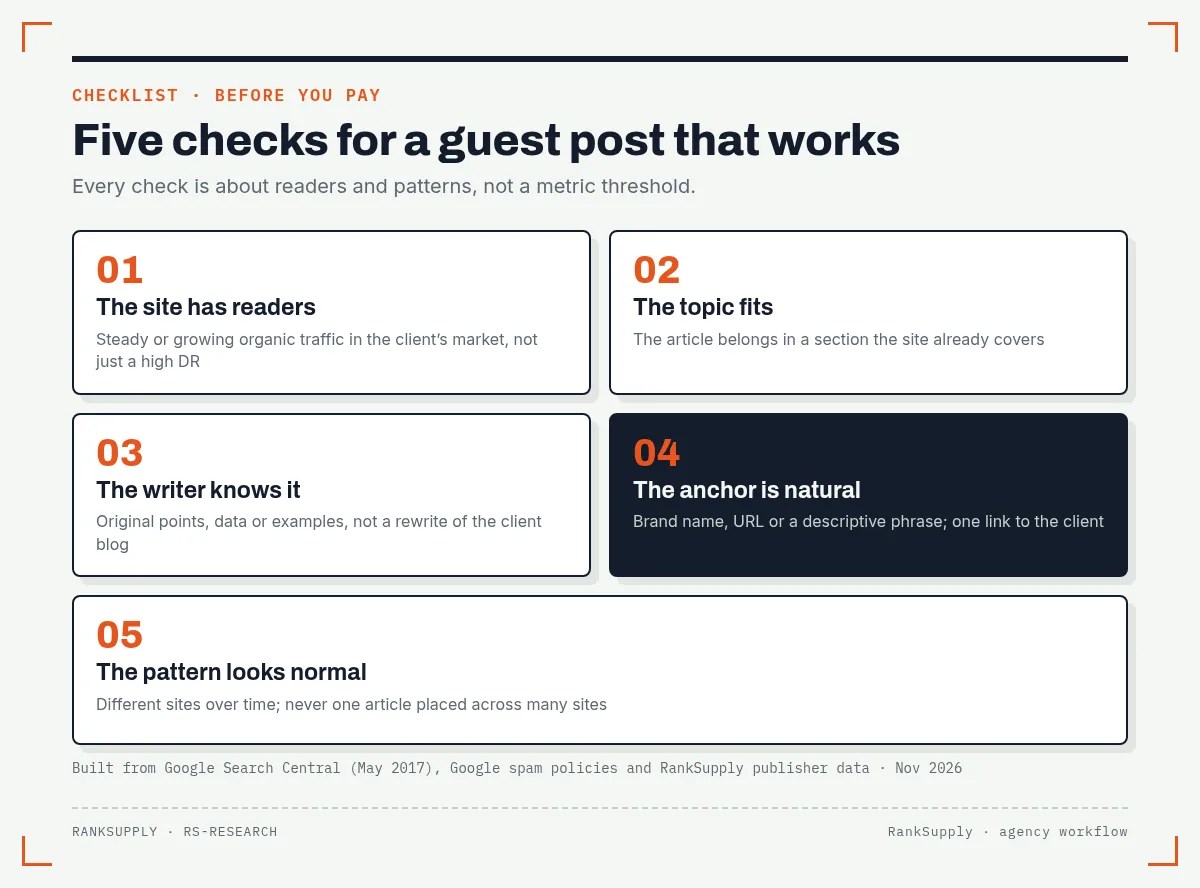
A guest post works in 2026 when a reader would find it useful even if it had no link. In practice, that comes down to five checks agencies can apply before paying:
- The site has readers. Organic traffic that is steady or growing, in the client’s market, not just a high DR.
- The topic fits. The article belongs in a section the site already covers, so it is integrated with the rest of the publication.
- The writer knows the subject. Original points, data or examples, not a rewrite of the client’s own blog.
- The anchor is natural. Brand name, URL or a descriptive phrase, and one link to the client rather than several.
- The pattern looks normal. A spread of different sites over time, never the same article placed across many sites.
Paid placements also raise the link-attribute question. Google’s policy asks that paid links be qualified with rel="sponsored" or rel="nofollow". Most of the market does not sell them that way: 99.2% of the listings with a stated link attribute in our dataset were sold as dofollow. Agencies should know both facts, explain the trade-off to clients in writing, and keep the other four checks strict, because those are what separate an article from a link scheme.
How much does a guest post that works cost?
A guest post on a site with real traffic usually costs more than the market median, and the premium buys readers rather than metrics. In our study, the median list price across all 69,597 listings was $336, with half between $161 and $734. By traffic band, the median rose from $181 for sites under 100 monthly visits to $400 at 1,000 to 9,999 visits and $615.50 at 10,000 to 99,999 visits.
A cheap post on a site with no readers is not a bargain if Google discounts the link and no one reads the mention. The full price tables by DR, traffic, topic and country are in our guest post pricing 2026 report.
When does guest posting not work?
- When the goal is volume. Dozens of posts a month on sites that publish anything is the large-scale pattern Google described in 2017.
- When anchors are exact-match keywords. Google’s spam policies name optimized anchors in guest posts as link spam.
- When the host site sells to everyone. Sites whose recent posts are mostly sponsored and off-topic look like the link-selling sites Google says SpamBrain can detect.
- When the client’s site is the problem. Guest posts send authority and attention to a page; they cannot fix thin content, poor indexing or a weak offer.
- When results are promised. No one controls rankings or AI answers. Report placements, dates and follow status, then measure.
If guest posts are a poor fit for a campaign, niche edits on aged pages or Digital PR may suit it better. Our comparison of guest posts vs niche edits vs Digital PR explains when to use each.
How does RankSupply handle guest posts for agencies?
RankSupply supplies white-label guest posting services for SEO agencies on traffic-checked sites drawn from 100k+ publishers, judged on organic traffic and topic fit rather than DR alone. For software clients we also offer ~500 SaaS niche edits. We serve agencies in the US, UK and Canada, report every placement with its URL and follow status, and do not promise rankings or AI mentions.
FAQ
Does guest posting still work in 2026?
Yes, when the post is a genuine article on a site with real organic readers, names the brand and uses natural anchor text. Google says it does not discourage guest articles that inform an audience, but it treats large-scale guest posting with keyword-rich anchors as link spam.
Is guest posting against Google’s guidelines?
No. Guest posting itself is allowed. Google’s spam policies target links with optimized anchor text in guest posts and paid links that pass ranking credit; Google says paid links are fine when qualified with rel="sponsored" or rel="nofollow".
Are guest posts still worth paying for?
They can be, if the host site has real traffic. In RankSupply’s study of 69,597 publisher listings, 30.4% of DR 50+ sites reported fewer than 1,000 monthly organic visits, so price and DR alone are poor guides. Check traffic, topic fit and the site’s other sponsored posts first.
Do guest posts help you appear in AI answers?
They can help when they mention the brand on relevant sites. Ahrefs’ 75,000-brand study found branded web mentions correlate with ChatGPT visibility at 0.664, while link counts showed very weak correlations. Correlation is not causation.
What anchor text is safe for guest posts?
Brand names, bare URLs and descriptive phrases that read naturally. Google’s spam policies list optimized anchor text in guest posts as link spam, and Ahrefs found branded anchors correlate with AI visibility.
Guest posting still works when it is treated as publishing rather than link buying: a useful article, on a site people read, that names the brand. Agencies that check traffic before DR and keep anchors natural get the benefit; agencies that buy volume pay for links Google has learned to ignore.