
FIG. — The three things cited pages have in common: eligibility, fan-out coverage, and corroboration from other sites.
How to get cited in AI Overviews comes down to three things: a page that is indexed and snippet-eligible, content that answers the sub-questions Google fans out to, and mentions on sites Google already trusts. This playbook is for SEO agencies whose clients ask why a competitor appears in the AI Overview and they do not. Every claim below is tied to Google’s own documentation, a dated third-party study, or RankSupply’s 69,597-listing publisher dataset. None of it guarantees a citation.
What makes a page eligible to be cited in AI Overviews?
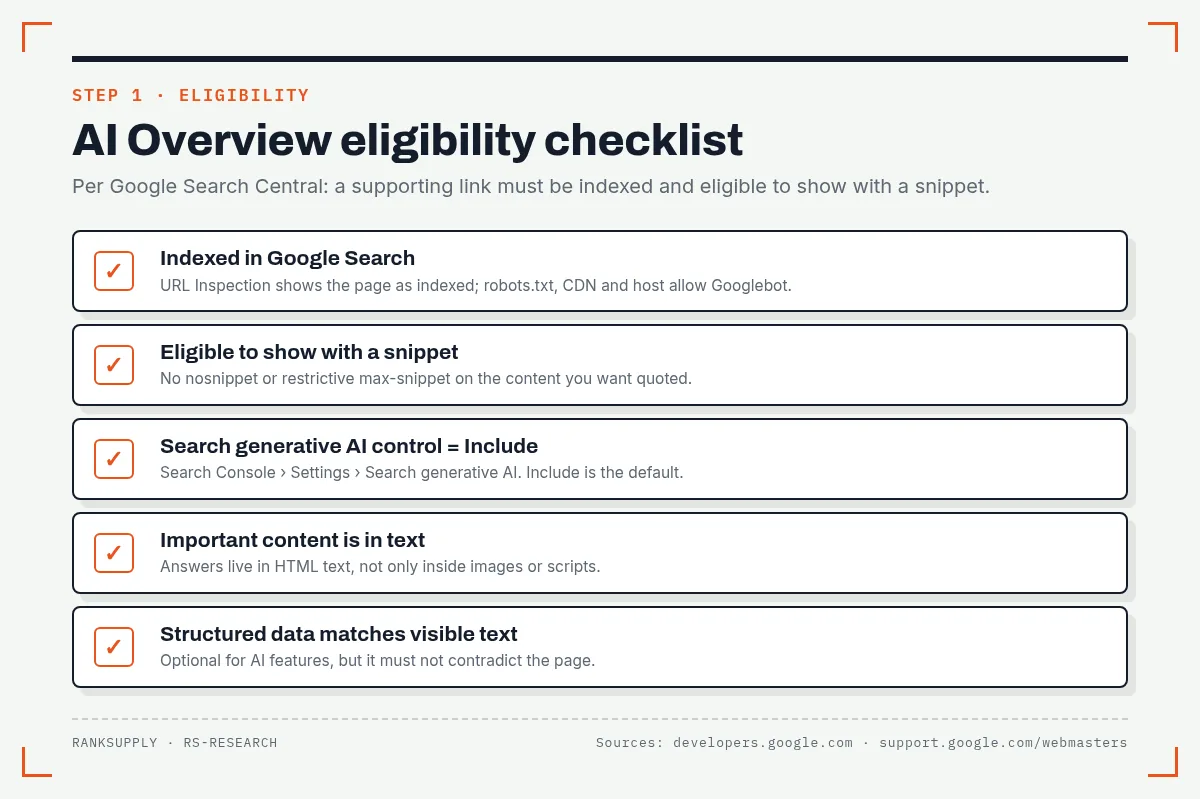
Google’s documentation on AI features is explicit: to be shown as a supporting link in AI Overviews or AI Mode, a page must be indexed and eligible to be shown in Google Search with a snippet, and there are no additional technical requirements (Google Search Central). That turns eligibility into a short checklist:
- Indexed. Confirm the URL with URL Inspection in Search Console. Make sure robots.txt and any CDN or firewall allow Googlebot.
- Snippet-eligible.
nosnippet,data-nosnippetand a lowmax-snippetvalue all limit what Google can show from a page, including in AI features. - Search generative AI control set to Include. Search Console has a Settings › Search generative AI control, rolled out to all sites worldwide as of August 31, 2026. Include is the default. Exclude removes a site’s links and content from AI Overviews, AI Mode and generative features in Discover (Search Console Help).
- Answers in text. Google lists making important content available in textual form among the SEO basics that still apply to AI features.
What is query fan-out, and how do you find the sub-questions?
Google describes query fan-out as a set of concurrent, related queries the model generates to fetch more results for the user’s question (Google’s guide to optimizing for generative AI features, published May 15, 2026). A page can be cited for one of those sub-questions even when it does not rank for the head term.
To map the fan-out for a client query:
- Pull People Also Ask questions and autocomplete suggestions for the head term.
- Export the long, question-style queries the page already earns impressions for in Search Console.
- Ask ChatGPT and Claude the head question with search turned on, and note the searches they report running. Their phrasing often differs from the keyword you targeted.
- Group the results into five to eight sub-questions a buyer would actually ask.
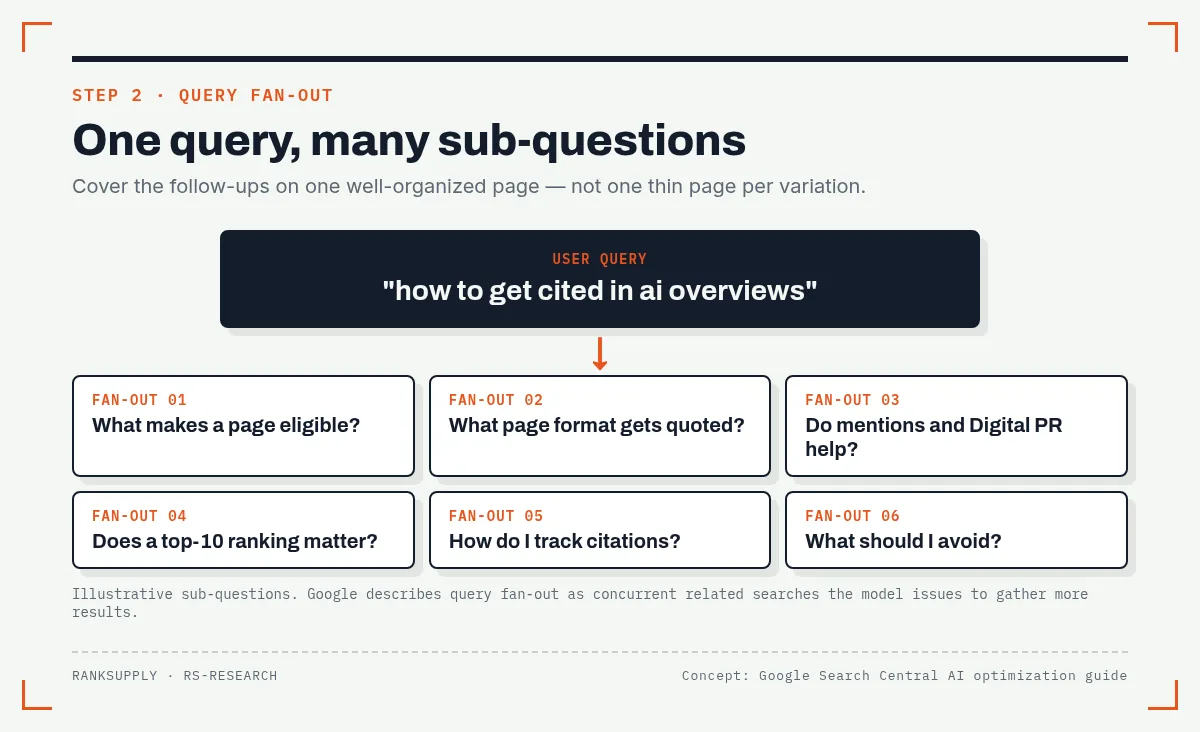
Keep those sub-questions on one page. Google’s guide warns that creating separate content for every fan-out variation, primarily to manipulate rankings or AI responses, violates its scaled content abuse spam policy.
What page format gets lifted into AI Overviews?
No format guarantees selection, but pages that get quoted tend to share traits that also help human readers:
- A direct answer in the first two sentences, using the language of the question.
- One subheading per sub-question, worded the way people ask it.
- Self-contained sentences that name their subject. “RankSupply’s study of 69,597 listings found…” can be quoted on its own; “It found…” cannot.
- Numbers with a named, dated source and a link.
- A visible byline and a last-reviewed date that match the structured data.
Google’s guide says structured data is not required for generative AI search, that there is no special schema.org markup to add, and that breaking content into tiny “chunks” is unnecessary. Use Article, FAQPage and BreadcrumbList markup when it accurately describes the page, not as an AI lever.
Do mentions, Digital PR and press releases help you get cited?
Corroboration from other sites appears to matter. Ahrefs’ study of 75,000 brands (May 26, 2025) found web mentions correlated with AI Overview visibility at 0.664, versus 0.218 for backlinks, and cautioned that correlation is not causation (Ahrefs, May 2025). RankSupply’s GEO link building guide covers what that study means for link budgets.
The durable route to mentions is editorial: news coverage, expert quotes, original data and industry roundups. That is the lane Digital PR placements are built for: brand mentions, with or without a link, on domains Google already crawls heavily.
Press releases are a faster, weaker signal. In September 2026, Edward Sturm documented the “king of AEO” episode: a press release costing about $6 used an uncontested phrase in its title, URL, H1 and first sentence, and a few hours later Google’s AI Overview cited it (Edward Sturm). The same write-up notes the AI Overview then repeated a made-up event as fact. The lesson is narrow. Exact-phrase placement can move an AI Overview on a query nobody else is competing for; it does not flip contested commercial queries. Google’s guide also says seeking inauthentic mentions “isn’t as helpful as it might seem,” because AI features depend on the same ranking and spam systems as the rest of Search.
Does ranking in the top 10 matter for AI Overview citations?
It helps, but it is not required. Ahrefs’ March 2, 2026 update, covering 863,000 keyword SERPs and 4 million AI Overview URLs, found that 37.9% of cited URLs also appeared in the top 10 results for the same query, 31.2% in positions 11–100, and 31.0% outside the top 100 (Ahrefs, March 2026).
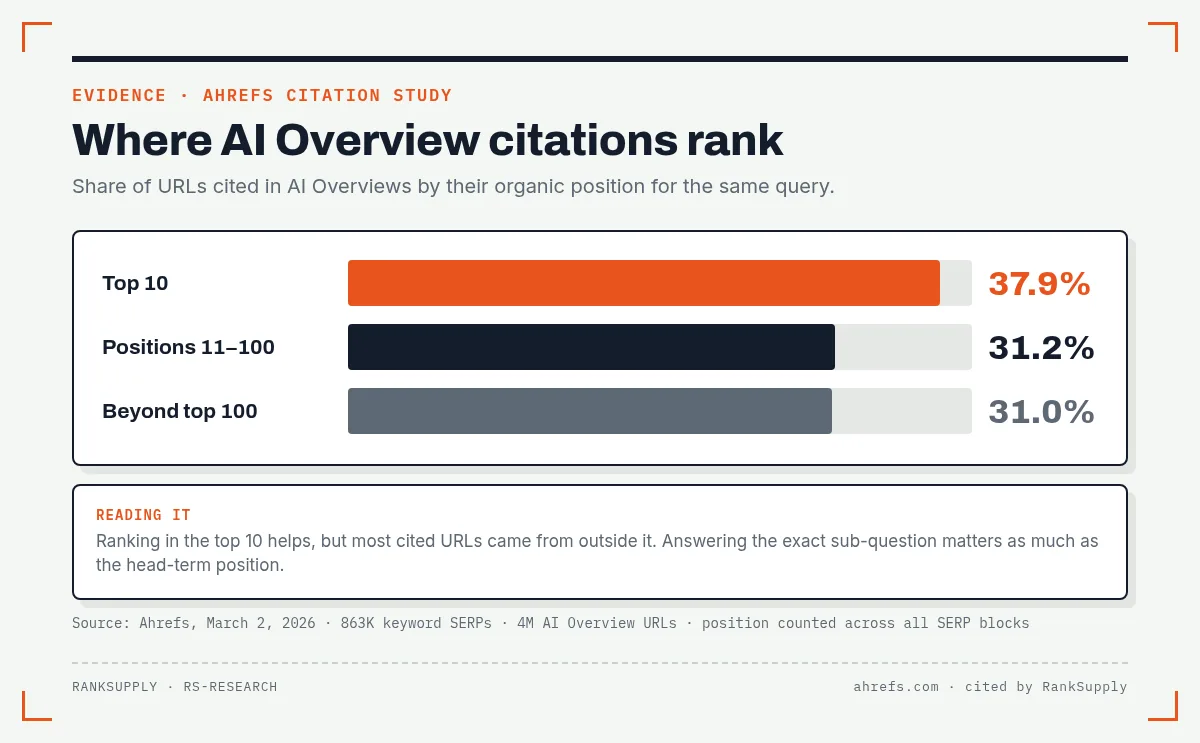
For link building, that shifts the target from one head-term ranking to the pages answering each sub-question. Domain Rating alone is a weak filter: in RankSupply’s guest post pricing 2026 study, 30.4% of 17,442 DR 50+ listings reported fewer than 1,000 monthly organic visits. Niche edits on aged, traffic-bearing pages and guest posts on vetted hosts are the two placement types that support a citation-candidate page directly. RankSupply sources placements from 100k+ publishers and keeps ~500 SaaS niche edits for software clients.
How does ChatGPT choose its sources?
ChatGPT search is separate from Google and has its own gate. OpenAI says OAI-SearchBot is used to surface websites in ChatGPT’s search features, and sites that opt out of OAI-SearchBot will not be shown in ChatGPT search answers, though they can still appear as navigational links (OpenAI crawler documentation). OpenAI says robots.txt changes take about 24 hours to apply to search results.
OpenAI does not publish a source-selection formula, so allow OAI-SearchBot and earn the same third-party mentions that help in Google. Blocking GPTBot, which crawls for model training, is a separate setting and does not by itself remove a site from ChatGPT search.
How do you track AI Overview citations?
Search Console now has a Generative AI performance report, available to all sites as of August 31, 2026. It shows impressions from AI Overviews and AI Mode over time, by page, device and country (Search Console Help). Traffic from AI features is also counted in the Performance report under the “Web” search type.
Add a dated manual log for what the report cannot show, which is who else gets cited:
- Fix 10–20 client prompts and check them on the same day each month.
- Record whether an AI Overview appears, which URLs are cited, and whether the client is named without a link.
- Save dated screenshots and label the method: signed in or out, location, device.
Report what you observed, with dates. Google says AI Overviews are shown only when its systems judge them additive to classic results and often don’t trigger, so a missing Overview is not always a content problem.
What should agencies avoid?
- Mass fan-out pages. One thin page per query variation is the scaled content pattern Google’s guide calls out.
- Manufactured mentions. Networks of low-quality pages repeating a brand name are what Google’s spam systems exist to filter.
- AI text files as a Google tactic. Google says Search ignores llms.txt files; they neither help nor harm Google visibility, though other services may read them.
- Opting out by accident. Check the Search generative AI control and snippet settings before diagnosing content.
- Invented claims. The king of AEO episode shows an AI Overview can repeat a false claim. That is a brand risk, not a strategy.
FAQ
How do you get cited in AI Overviews?
Make sure the page is indexed and eligible to show with a snippet, answer the sub-questions Google’s query fan-out searches for on one well-organized page, and earn genuine mentions and links from sites Google already trusts. Google says there are no extra technical requirements for AI Overviews beyond those for Search.
Do you need special schema or an llms.txt file to appear in AI Overviews?
No. Google’s AI features documentation says there is no special schema.org structured data, AI text file or markup needed to appear in AI Overviews or AI Mode, and Google’s May 2026 optimization guide says Google Search ignores llms.txt files. Structured data should still match the visible text when you use it.
Can a page be cited in AI Overviews without ranking in the top 10?
Yes. Ahrefs’ March 2026 study of 863,000 keyword SERPs found 37.9% of URLs cited in AI Overviews also ranked in the top 10 for the same query, while 31.2% ranked 11–100 and 31.0% ranked outside the top 100.
Can you keep your site out of AI Overviews?
Yes. The Search generative AI control in Search Console (Settings › Search generative AI) lets a site exclude its links and content from AI Overviews, AI Mode and generative features in Discover. Excluded sites receive no traffic or impressions from those features. Snippet controls such as nosnippet and max-snippet also limit what Google can show.
How do you see AI Overview performance in Search Console?
Use the Generative AI performance report, rolled out to all sites as of August 31, 2026. It shows impressions from AI Overviews and AI Mode over time and by page, device and country. Traffic from AI features is also included in the Performance report under the Web search type.
How do you get your brand mentioned in ChatGPT?
Allow OAI-SearchBot in robots.txt, because OpenAI says sites that opt out of it will not be shown in ChatGPT search answers. Keep answers in crawlable HTML and earn third-party mentions on sites people already read. OpenAI does not publish how ChatGPT ranks or selects sources.
Getting cited in AI Overviews is eligibility, plus a page that answers the fan-out better than the alternatives, plus corroboration from other sites. Fix the technical floor first, write one strong page per topic, then earn mentions and links on hosts with real readers.