
FIG. — Links still count. Fewer of them count, and the weak ones count for less.
Do backlinks still matter in 2026? It is a fair question for any agency setting an off-page budget, because Google has spent years saying links are less important than they were, and AI answers now take clicks that used to go to ranked pages. This guide sets out what Google itself has said about links, what large studies show about pages with and without backlinks, how links relate to AI search, and what kind of link is still worth paying for. Every source was checked on 11 November 2026.
What does Google say about backlinks in 2026?
Google’s own documentation still describes links as a ranking input. Its guide to ranking systems says Google has “various systems that understand how pages link to each other as a way to determine what pages are about and which might be most helpful in response to a query,” and that PageRank “continues to be part of our core ranking systems” (Google ranking systems guide).
Google’s link best-practices page is just as direct: “Google uses links as a signal when determining the relevancy of pages and to find new pages to crawl” (Google link best practices). That sentence names two jobs. Links help Google decide what a page is relevant for, and they help Google find the page in the first place.

Has Google made links less important?
Yes, by Google’s own account links carry less weight than they once did. At SERP Conf in April 2024, Google analyst Gary Illyes said: “We need very few links to rank pages… Over the years we’ve made links less important” (Search Engine Roundtable, April 2024). Search Engine Roundtable noted he had made similar comments in earlier years.
“Less important” is not the same as “not used.” The practical reading for agencies is that link volume has stopped being a reliable lever. A page with strong content and a few relevant links can rank where a weaker page with many links does not, and buying more links of the same kind gives smaller returns than it used to.
What does the data show about backlinks and organic traffic?
Large studies still find that pages without backlinks rarely earn meaningful Google traffic. Ahrefs studied about 14 billion pages in its Content Explorer index and found that 96.55% get no traffic from Google. It also found about 20 million pages with no referring domains, of which only 2,997 get more than 1,000 search visits a month, roughly 1 in every 6,671 (Ahrefs search traffic study, December 2023).
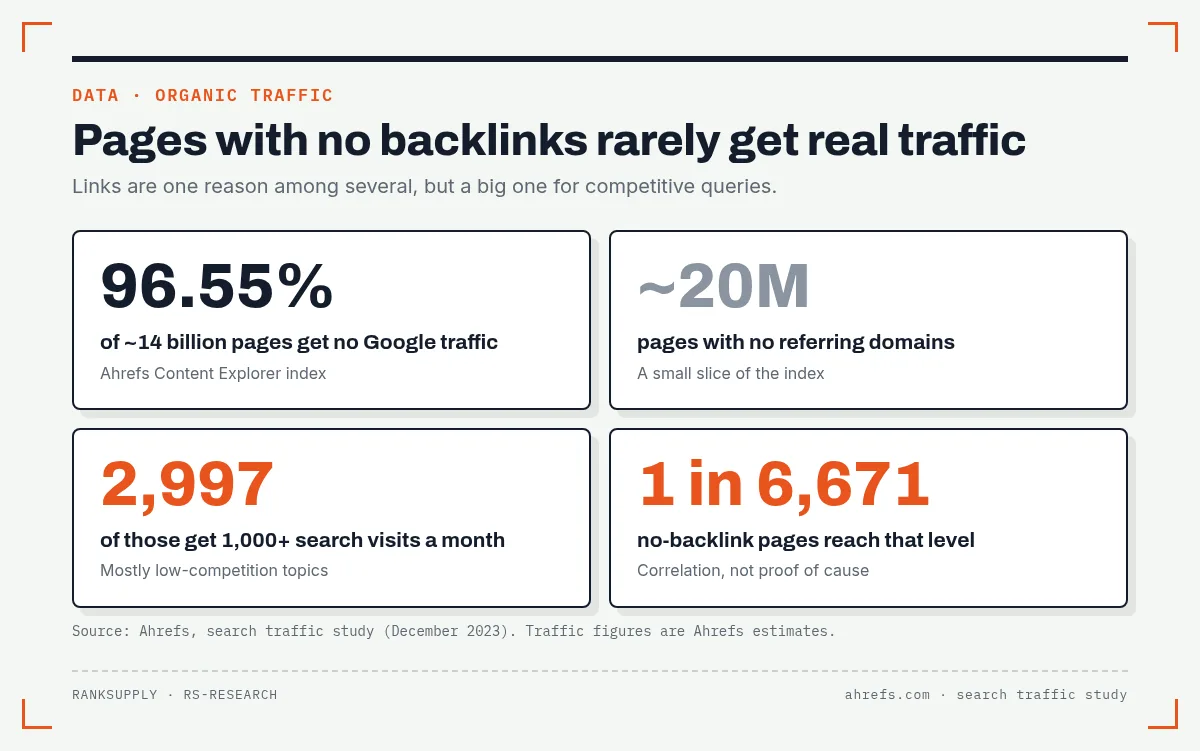
Ahrefs is careful about what this proves. It says correlation does not imply causation, that the traffic numbers are its own estimates, and that the pages without backlinks that do get traffic are almost all about low-competition topics. Lack of search demand and a mismatch with search intent are the other main reasons pages get no traffic, so links are one cause among several, not the only one.
Do backlinks matter for AI search?
Backlinks matter less directly for AI answers than brand mentions do, but they still affect which pages get found. In Ahrefs’ study of 75,000 brands, branded web mentions correlated with brand visibility at 0.664 in ChatGPT, 0.709 in AI Mode and 0.656 in AI Overviews, while link counts showed very weak correlations (Ahrefs, December 2025). Ahrefs again notes that correlation is not causation.
The two signals are not separate in practice. AI Overviews and AI Mode draw on pages that Google has already crawled and indexed, and links are one of the ways Google finds and weighs those pages. A placement that names the client in a relevant article on a site with real readers is both a backlink and a brand mention. Our analysis of brand mentions vs backlinks for AI search goes through that overlap in detail.
Which backlinks still count in 2026?
The links that still count are relevant, editorially placed links on sites that have their own audience. Google’s spam policies list “links with optimized anchor text in articles, guest posts, or press releases distributed on other sites” as link spam, along with paid links that pass ranking credit, and say paid links are fine when qualified with rel="sponsored" or rel="nofollow" (Google spam policies).
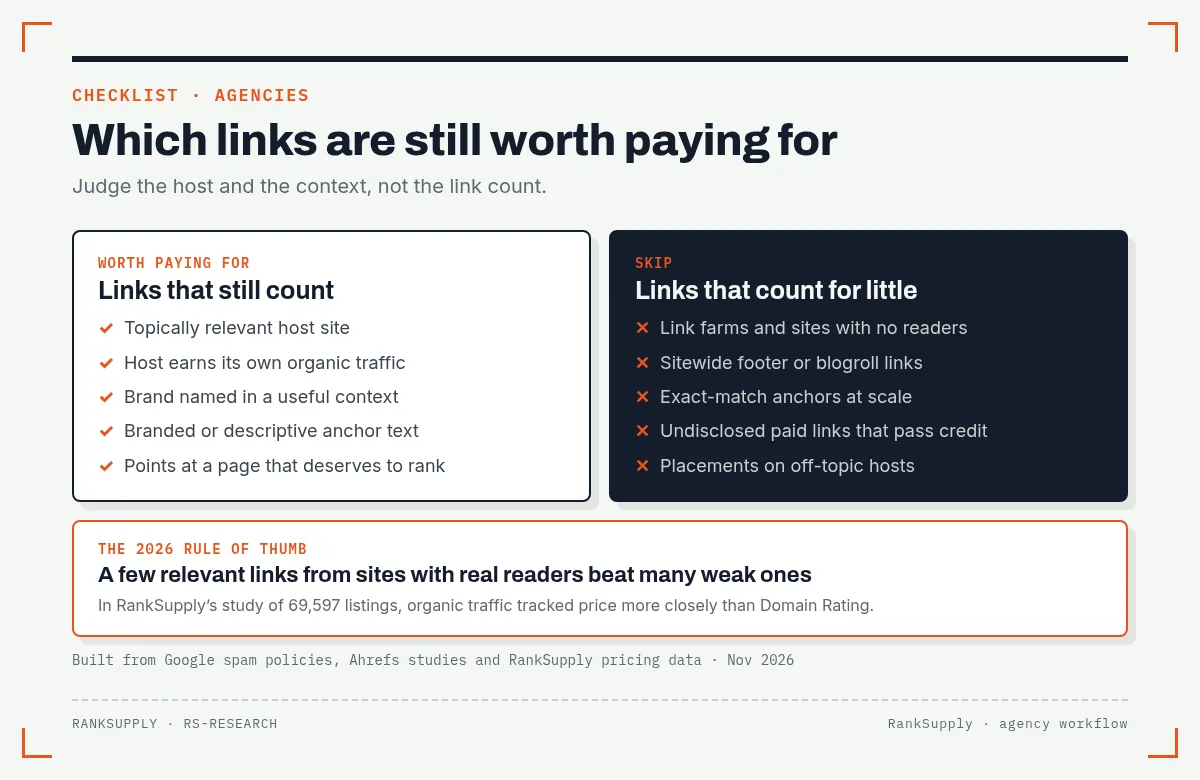
- Relevant host. The site covers the same topic as the client, so the link makes sense to a reader.
- Real traffic. The host earns its own organic visitors. In RankSupply’s guest post pricing 2026 study of 69,597 publisher listings, organic traffic tracked price more closely than Domain Rating, and the median list price was $336.
- The brand in context. The article names the client where it is useful, which also creates a mention.
- A natural anchor. Branded or descriptive anchors, not the same exact-match keyword on every placement.
- A page that deserves to rank. Links send authority to a page; they cannot fix thin content or an indexing problem.
How should agencies plan link building in 2026?
Agencies should plan for fewer, better links aimed at pages that can already convert, rather than monthly link counts. In practice that means checking each host’s traffic and topic before paying, pointing placements at service and category pages that have solid content, and reporting every link with its URL, live date and follow attribute.
It also means choosing the format to fit the goal. Guest posts on traffic-checked sites suit new, topical links with the brand named in context. Niche edits suit adding a link to an existing article that already ranks. Digital PR suits brands with data or news worth covering. Our comparison of guest posts vs niche edits vs Digital PR explains how to brief each one.
How does RankSupply approach backlinks for agencies?
RankSupply fulfills link building white-label for SEO agencies in the US, UK and Canada. We source placements from 100k+ publishers, plus ~500 SaaS niche edits for software clients, and we filter hosts on organic traffic and topic, not on Domain Rating alone. Agencies can order white-label link building under their own brand, and every placement is reported with its URL and follow status. We do not promise rankings or AI mentions.
FAQ
Do backlinks still matter in 2026?
Yes. Google says it uses links as a signal of relevance and to discover pages, and PageRank is still part of its core ranking systems. Google has also said it needs very few links to rank pages, so relevance and quality matter more than volume.
Are backlinks still a Google ranking factor?
Yes. Google’s ranking systems guide says its link analysis systems help it understand what pages are about, and that PageRank continues to be part of its core ranking systems.
Can a page rank without backlinks?
It can, but rarely for competitive queries. Ahrefs found about 20 million pages with no referring domains, and only 2,997 of them get more than 1,000 Google visits a month. Most were about low-competition topics.
Do backlinks help with AI search?
Indirectly. Ahrefs’ study of 75,000 brands found brand mentions correlate with AI visibility far more than link counts do. Links still help Google find and weigh the pages that AI Overviews and AI Mode draw on.
How many backlinks do you need to rank in 2026?
There is no fixed number. Google’s Gary Illyes said in 2024 that Google needs very few links to rank pages. The number depends on the competition for the query, and a few relevant links from sites with real traffic usually beat many weak ones.
Backlinks still matter in 2026, but not in the way they did a decade ago. Google keeps links in its core systems while needing fewer of them, the data still shows that pages without links rarely win competitive traffic, and AI search rewards the brand mentions that good placements also create. The budget question is no longer how many links, but which ones.