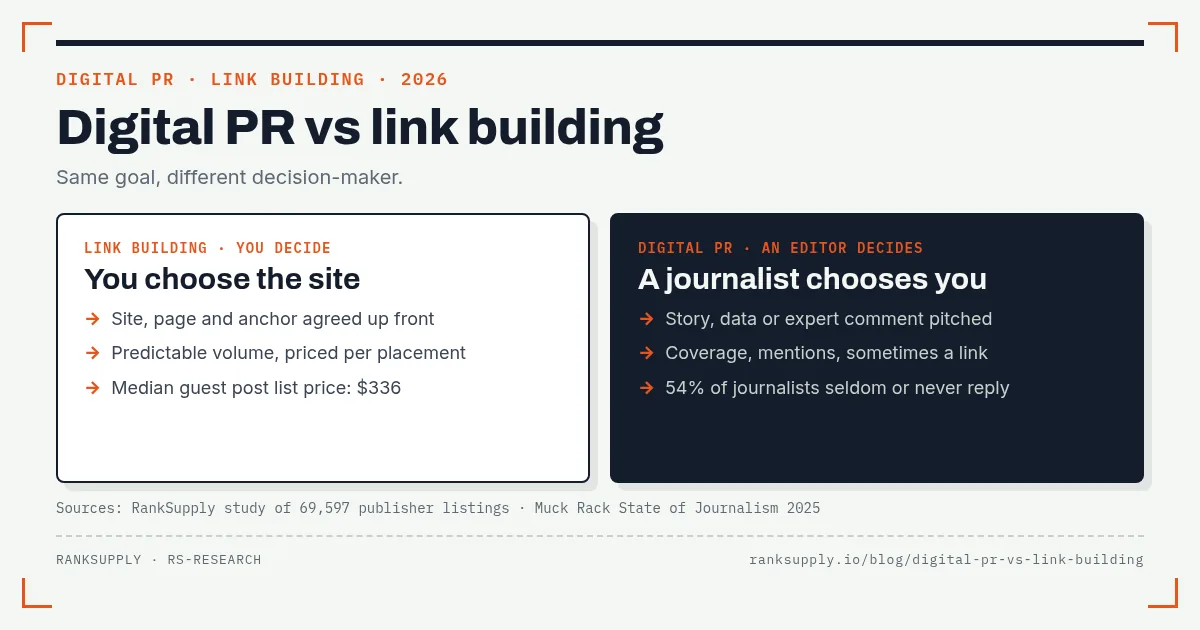
FIG. — The core difference is who makes the final call: you, or an editor.
Digital PR vs link building is one of the first questions clients ask when an agency proposes an off-page budget, and the two are often sold as if they were the same product. They overlap, because both can produce links from other sites, but they work differently, cost differently and fail differently. This guide explains each method, what Google has said about them, how they affect AI search, and how agencies can choose between them. Every source was checked on 9 November 2026.
What is the difference between Digital PR and link building?
Link building is the practice of getting links placed on other websites, usually by arranging the placement directly with a publisher. The common formats are guest posts, which are new articles on a host site, and niche edits, which add a link to an article that already exists. The buyer, or the agency’s vendor, picks the site, agrees the topic and knows roughly what will go live and when.
Digital PR is the practice of pitching stories, data or expert comment to journalists and editors so they write about the brand. The output is coverage: a news story, a quote, a mention in a roundup, and sometimes a link. The journalist decides what to publish, whether to name the brand and whether to link. Paid press-release syndication sits between the two: the placement is bought, but the links are usually nofollow and the value is mainly the mention.
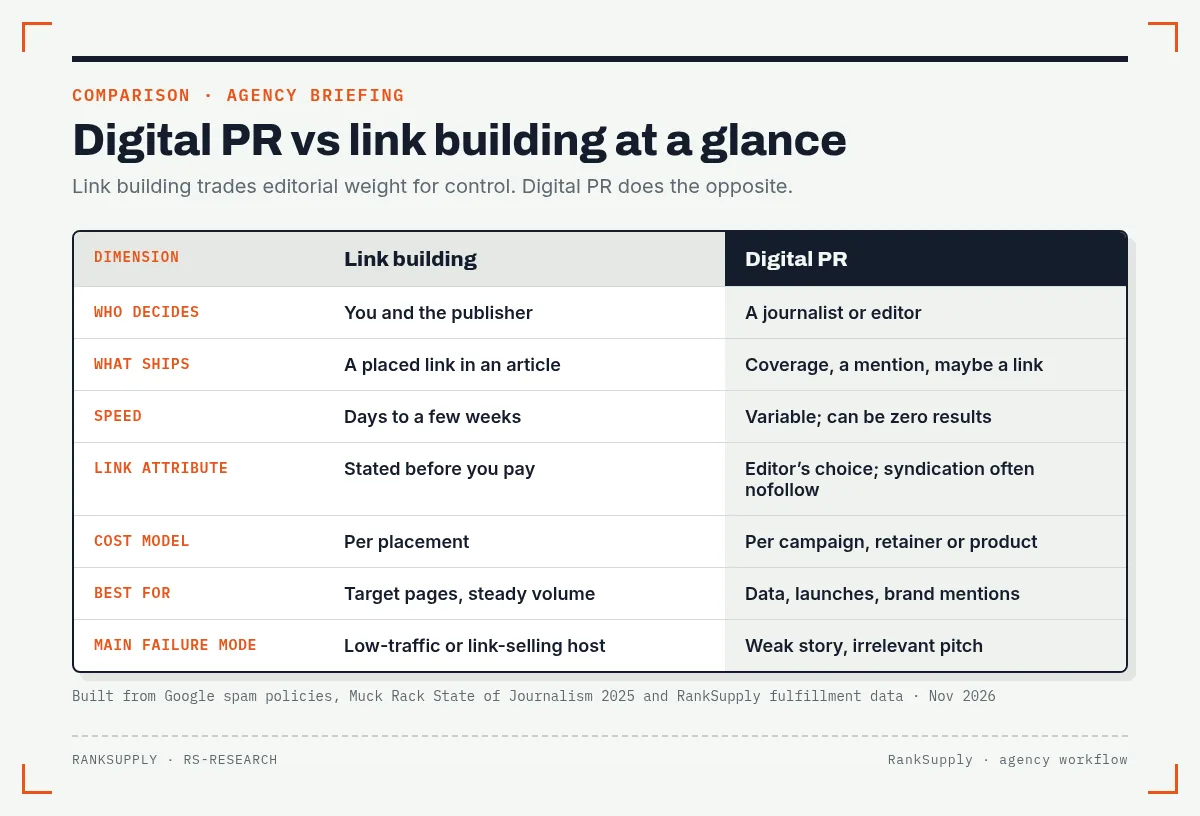
How much control do you get with each?
Link building gives an agency far more control than Digital PR, which is why it is easier to scope, price and report. With a guest post or niche edit, the agency approves the host site before anything is paid for, and the deliverable is a live URL with a known follow attribute.
Digital PR outcomes are uncertain by design, because a third party has to say yes. Muck Rack’s State of Journalism 2025 survey of 1,515 journalists found that 84% say at least some of their stories originate from PR pitches, but 54% say they seldom or never respond to pitches, and 55% receive more than five pitches on a normal working day (Muck Rack, June 2025).
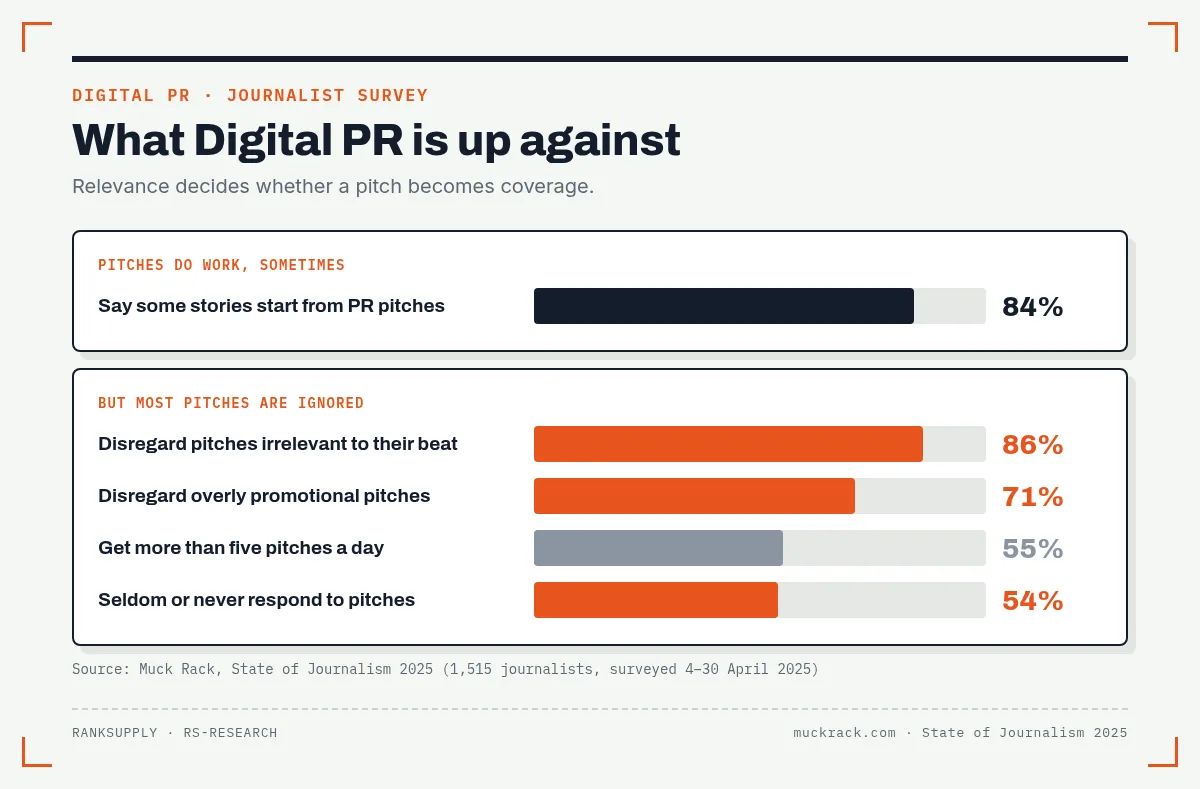
The same survey shows what gets a pitch ignored: 86% of journalists disregard pitches that are not relevant to their beat, and 71% disregard pitches that are overly promotional. That is the main reason Digital PR cannot be sold as a fixed number of links. A campaign built on a weak story can produce no coverage at all.
Does Google treat Digital PR and link building differently?
Google judges links by how they were obtained, not by what the tactic is called. Its spam policies list as link spam “links with optimized anchor text in articles, guest posts, or press releases distributed on other sites,” and paid links that pass ranking credit. The same policies say buying and selling links is “a normal part of the economy of the web” when the links are qualified with rel="sponsored" or rel="nofollow" (Google spam policies).
Google’s John Mueller has spoken positively about Digital PR specifically. In January 2021 he wrote: “I love some of the things I see from digital pr, it’s a shame it often gets bucketed with the spammy kind of link building” (Search Engine Roundtable, January 2021). The point is the editorial decision: a journalist who links because a story is useful creates the kind of link Google’s systems are built to reward. A press release stuffed with keyword anchors is still link spam, even if it is called PR.
Which is better for AI search visibility?
Digital PR tends to produce the signal that tracks AI visibility most closely, which is brand mentions on third-party sites. In Ahrefs’ study of 75,000 brands, branded web mentions correlated with brand visibility at 0.664 in ChatGPT, 0.709 in AI Mode and 0.656 in AI Overviews, while link counts showed very weak correlations (Ahrefs, December 2025). Ahrefs notes that correlation is not causation.
Link building can produce mentions too, if the placement names the brand in a relevant article rather than only linking a keyword. A guest post that discusses the client by name on a site with real readers is both a link and a mention. Our analysis of brand mentions vs backlinks for AI search explains why links still matter for getting pages found and indexed, even when mentions do more of the work in AI answers.
How do Digital PR and link building costs compare?
Link building is priced per placement, so the cost is known before the work starts. In RankSupply’s guest post pricing 2026 study of 69,597 publisher listings, the median vendor list price was $336, with half of all listings between $161 and $734. Organic traffic tracked price more closely than Domain Rating.
Digital PR is usually priced per campaign, per retainer or per product such as a syndicated release or a contributor placement, so the cost per link is only known afterwards. A campaign that lands three strong news links can be cheaper per link than guest posts; one that lands none costs the full fee for nothing. Agencies should agree in writing what a Digital PR fee buys: the asset, the outreach, or guaranteed placements, because those are different products.
When should an agency choose link building or Digital PR?
Choose link building when the goal is specific pages ranking for specific queries and the client needs a predictable monthly volume. Choose Digital PR when the client has something journalists would want: original data, a launch, an expert with a view, or a timely angle. Use both when the budget allows a steady base of placements plus occasional campaigns.

- Link building fits local and niche sites, money pages that need topical links, fixed budgets and clients who want a named list of placements.
- Digital PR fits brands with data or news, categories where trust and press coverage matter, and clients who care about being named in AI answers.
- Neither fits a site with thin content, indexing problems or a weak offer. Off-page work sends authority to a page; it cannot fix the page.
How do agencies combine Digital PR and link building?
Most agencies combine the two by using link building for steady, targeted placements and Digital PR for brand-level authority. A common pattern is guest posts and niche edits pointed at service and category pages each month, and a Digital PR campaign each quarter built on the client’s own data. The campaign earns mentions and links to a research page, and internal links pass that value to the pages the placements support.
Report the two separately. A placement report lists the URL, live date and follow status. A Digital PR report lists coverage, mentions, links and their attributes. Mixing them on one line hides which spend produced which result. Our comparison of guest posts vs niche edits vs Digital PR covers how to brief each lane.
How does RankSupply handle Digital PR and link building for agencies?
RankSupply fulfills both lanes white-label for SEO agencies in the US, UK and Canada. For link building we supply guest posts on traffic-checked sites drawn from 100k+ publishers, plus ~500 SaaS niche edits for software clients. Our Digital PR service quotes per product and labels DoFollow and NoFollow before you order. We report every placement with its URL and follow status, and we do not promise rankings, coverage or AI mentions.
FAQ
What is the difference between Digital PR and link building?
In link building, the agency chooses the site, page and usually the anchor, and pays for a placement. In Digital PR, the agency pitches a story or data to journalists, who decide whether to cover, mention or link to the brand.
Is Digital PR better than link building?
Neither is better in general. Link building is more predictable and easier to target at specific pages. Digital PR earns editorial coverage and brand mentions but has uncertain outcomes; Muck Rack’s 2025 survey found 54% of journalists seldom or never respond to pitches.
Is Digital PR a form of link building?
Partly. Digital PR often produces links, but its output is coverage and mentions, and many of the links it earns are decided by editors rather than arranged. Google’s John Mueller has said Digital PR is often wrongly grouped with spammy link building.
Does Digital PR help with AI search?
It can, because it produces brand mentions on third-party sites. Ahrefs’ study of 75,000 brands found branded web mentions correlate with ChatGPT visibility at 0.664, while link counts showed very weak correlations. Correlation is not causation.
How much does link building cost compared with Digital PR?
Link building is priced per placement; the median guest post list price in RankSupply’s study of 69,597 listings was $336. Digital PR is usually priced per campaign or product, so the cost per link is only known after the campaign.
Digital PR and link building are not rivals. Link building gives agencies control over where links go; Digital PR gives brands coverage they could not buy directly. The right choice depends on the client’s pages, budget and whether they have a story worth telling.