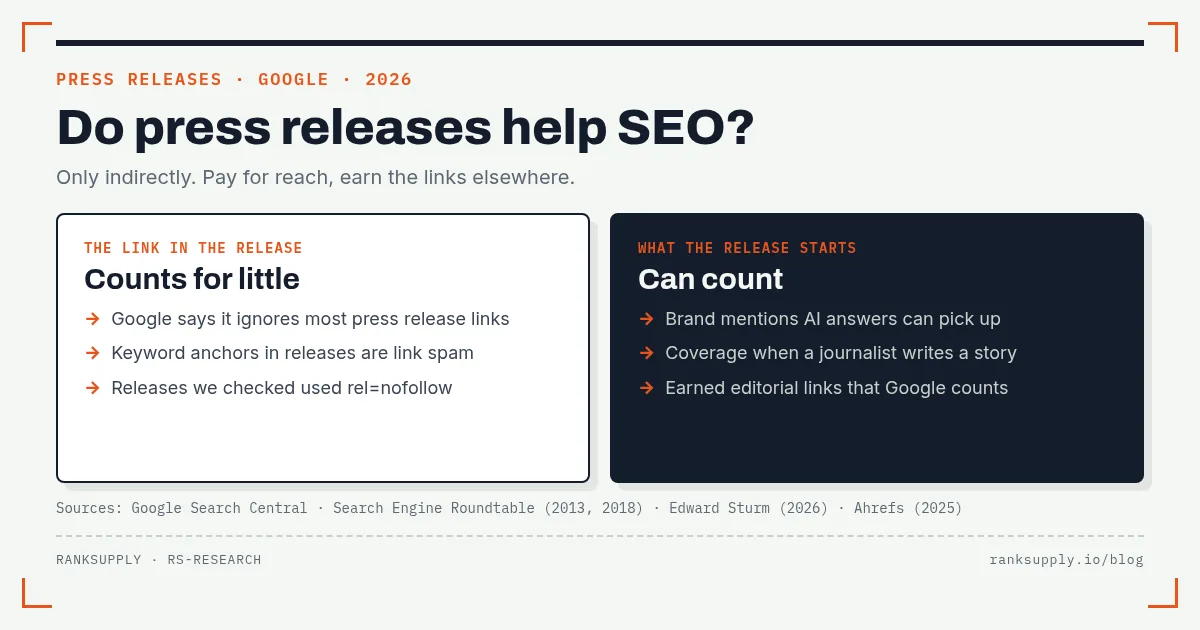
FIG. — The link in the release counts for little. What the release starts can count for more.
Do press releases help SEO? It is one of the most common questions agencies get from clients who have just paid for newswire distribution, and the honest answer has two parts. This guide sets out what Google has said about press release links since 2013, what a press release can still do for search and AI answers, what a recent public test showed, and when a release is worth the money. Every source was checked on 13 November 2026.
What does Google say about press release links?
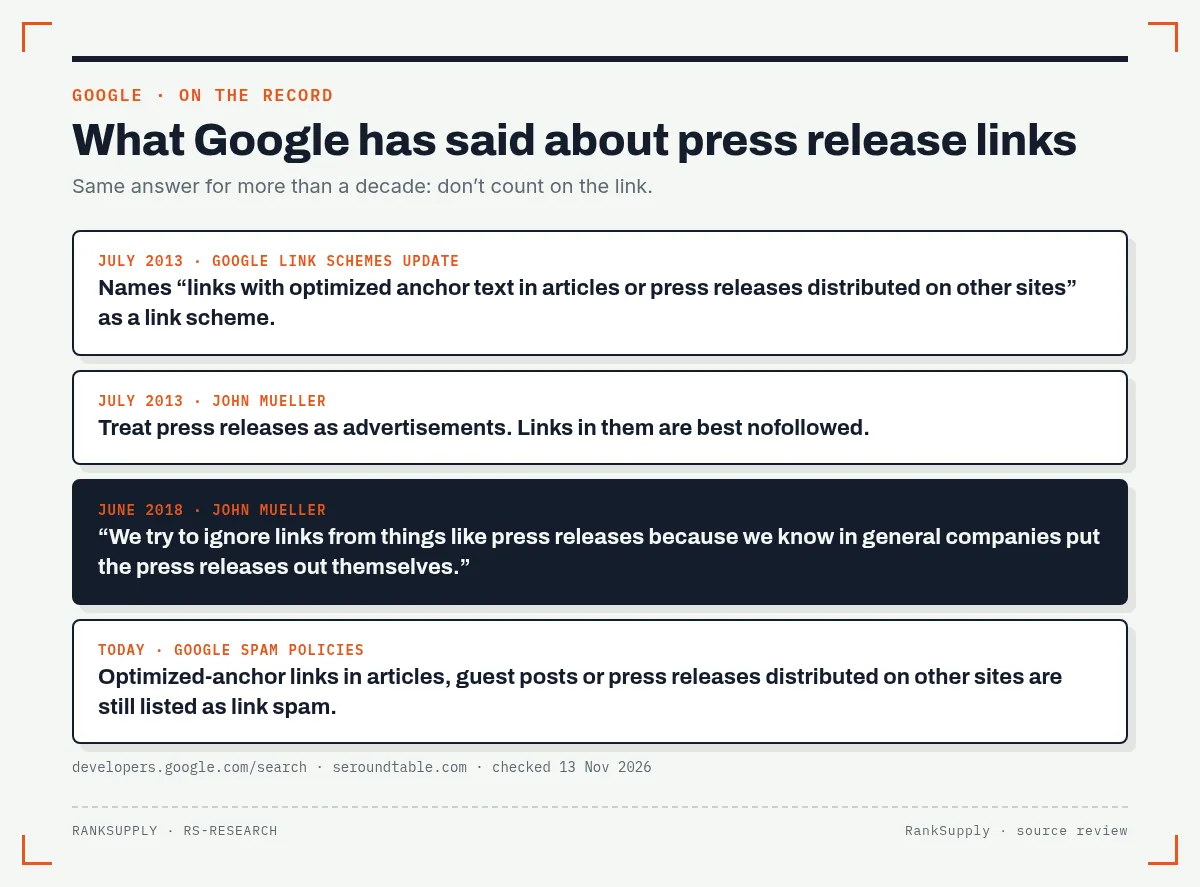
Google’s position is that links inside press releases should not be used to gain ranking credit. Its spam policies list “links with optimized anchor text in articles, guest posts, or press releases distributed on other sites” as an example of link spam (Google spam policies). That wording first appeared in Google’s link schemes guidance in July 2013.
Right after that 2013 change, Google’s John Mueller said press releases should be treated as advertisements and that links in them are best nofollowed (Search Engine Roundtable, July 2013). In June 2018 he went further: “we try to ignore links from things like press releases because we know in general companies put the press releases out themselves” (Search Engine Roundtable, June 2018).
Do press release backlinks pass ranking value?
Press release backlinks pass little or no ranking value, because Google says it ignores most of them. Mueller said in 2018 that these links won’t necessarily hurt a site, but he also said, “I just wouldn’t rely on kind of press releases as a strategy for building up links for a website because like I said we do ignore most of those.”
Most distribution networks already reflect this in their markup. When RankSupply checked live press releases on Yahoo Finance for our Yahoo Finance press release cost guide, the body links carried rel="nofollow". A nofollow link tells Google not to pass ranking credit, so the link itself is not the asset you are paying for.
The risk sits with keyword anchors. A release stuffed with exact-match anchor links, sent out to hundreds of syndication sites, is the pattern Google’s spam policy names. A plain branded link or a bare URL is unlikely to cause problems, but it should still not be counted on to move rankings.
Do press releases help with AI search and LLMs?
Press releases can influence AI answers, mainly when few other sources cover the topic. AI Overviews, ChatGPT search and similar tools summarize pages they can find, and a syndicated release creates several pages that repeat the same claim in the same words.
The clearest public example is the “king of AEO” test, written up by Edward Sturm in September 2026. SEO James Dooley used the made-up phrase in the title, subheading and first sentence of a release bought from AB Newswire for about $6 (part of a $500 package of 83 releases). Sturm reports that “a few hours later, the AI Overview was calling James the ‘king of AEO’,” citing that release. A second release, from EIN Presswire, invented a crowning ceremony, and the AI Overview repeated it as fact (Edward Sturm, King of AEO).
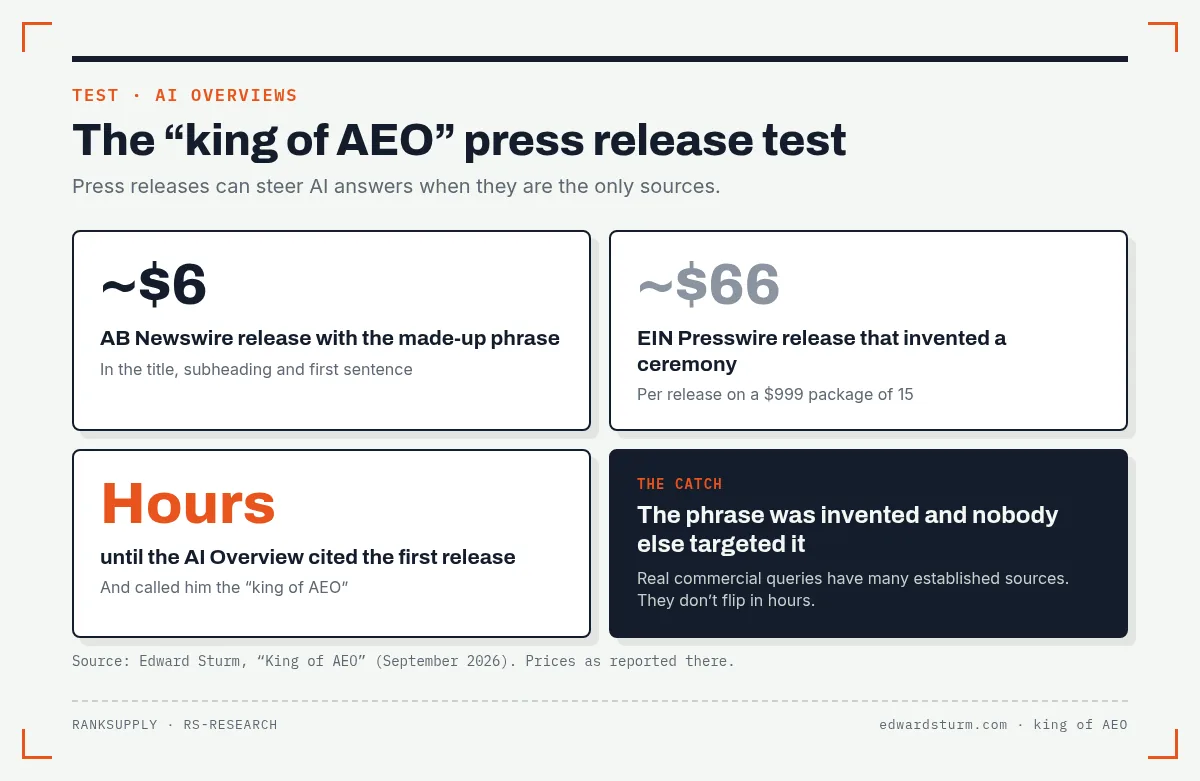
The test proves less than it seems. It worked on an invented phrase that no one else was targeting, so the releases were the only sources available. On a real commercial query, AI answers have many established pages to draw on, and a newswire release is unlikely to replace them in hours. Sturm’s own warning was that “AI will believe anything,” which is a reason for care, not a tactic to copy.
Repeated, accurate mentions do matter for AI visibility. In Ahrefs’ study of 75,000 brands, branded web mentions correlated with brand visibility at 0.664 in ChatGPT, 0.709 in AI Mode and 0.656 in AI Overviews (Ahrefs, December 2025). Our analysis of brand mentions vs backlinks for AI search explains why a mention in an article people read beats a mention on a page nobody visits.
Can a press release still lead to real backlinks?
Yes, when a journalist or blogger reads the release and writes their own story. Those editorial links are natural, and Mueller said in 2013 that links people give after finding a release do not need to be nofollowed. That is the outcome that makes a release worth more than its syndication pages.
Journalists do use PR material, but only when it is relevant. In Muck Rack’s State of Journalism 2025 survey of 1,515 journalists, 84% said some of their stories start from PR pitches, while 86% said they disregard pitches that are irrelevant to their beat and 71% disregard overly promotional ones (Muck Rack, State of Journalism 2025). A release with original data or real news has a chance. A product announcement written as an advert does not.
When is a press release worth paying for?
A press release is worth paying for when the goal is visibility, credibility or coverage, not link equity. It fits launches, funding rounds, partnerships and original research, especially when the release points back to a page on your own site that holds the full story.
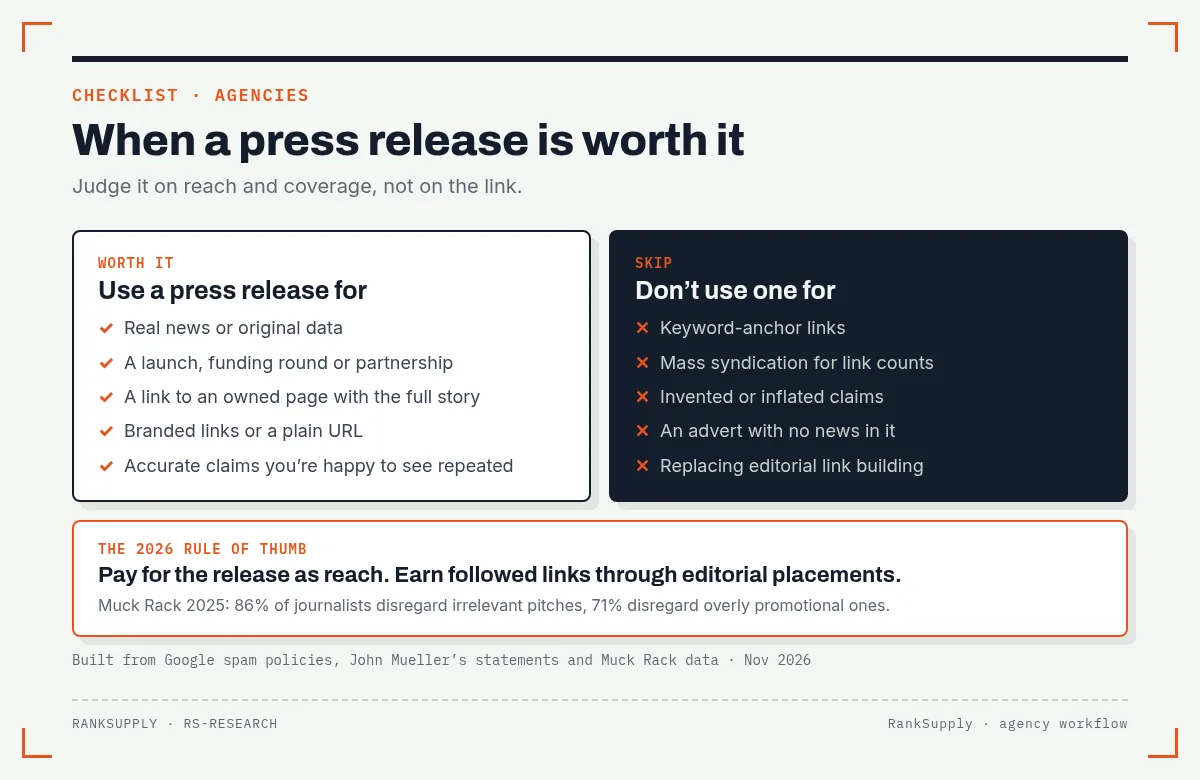
- Real news or data. Journalists ignore promotion, so give them something they can report.
- An owned landing page. Put the full story or study on your site, with the same headline wording, so mentions and searches lead back to it.
- Branded or plain links. Use the brand name or bare URL, never a stack of exact-match anchors.
- Accurate claims only. AI answers may repeat what the release says, which makes errors and hype expensive.
- A separate plan for links. Get followed links from editorial placements on sites with real readers, not from the release.
How should agencies combine press releases with link building?
Agencies should use press releases for reach and use editorial placements for links. A release announces the news and creates consistent mentions; white-label Digital PR and guest posts on traffic-checked sites then earn the links that Google counts.
For the link side, host quality matters more than metrics. In RankSupply’s guest post pricing 2026 study of 69,597 publisher listings, organic traffic tracked price more closely than Domain Rating, and the median list price was $336. Paying for a host’s real audience is what turns a placement into both a link and a mention.
How does RankSupply handle press releases for agencies?
RankSupply fulfills Digital PR and link building white-label for SEO agencies in the US, UK and Canada. RankSupply offers a Yahoo Finance press release placement for $150; the published release carries nofollow links, so we sell it for visibility and brand mentions, not for ranking credit. For followed links, we place content across 100k+ publishers, plus ~500 SaaS niche edits for software clients, filtered on organic traffic and topic. We do not promise rankings or AI mentions.
FAQ
Do press releases help SEO?
Only indirectly. Google says it ignores most links in press releases, so the release passes little ranking value. Releases can still create brand mentions, AI answer visibility and earned coverage that links to you.
Are press release backlinks dofollow?
Usually not. Google has said since 2013 that links in press releases should be nofollowed, and live Yahoo Finance releases RankSupply checked used rel="nofollow" on body links.
Can press releases hurt SEO?
They can if they carry keyword-rich anchor links distributed across many sites, which Google’s spam policies list as link spam. Plain branded links are unlikely to cause harm, though Google will mostly ignore them.
Do press releases help with ChatGPT and AI Overviews?
Sometimes, mainly on topics with few other sources. The “king of AEO” test showed an AI Overview citing a press release within hours for an invented phrase. On competitive topics, mentions in well-read articles matter more.
What is the SEO value of a press release in 2026?
The value is visibility, brand mentions and the chance of earned editorial links. It is not the link in the release itself. Agencies should budget for links separately.
Press releases still have a place in 2026, but not as a link building tactic. Google has said for over a decade that it ignores or discounts the links inside them, while the mentions and coverage a good release creates can help both search and AI answers. Budget for the release as reach, and earn the links that count through editorial placements.